Thursday, 18 October 2018

Most people go about habit change backwards. Here’s how to flip it.

“I’m on a diet, I shouldn’t eat that cake.”

“I’m going to try to exercise more this year.”

“I’m trying to lose weight, so I can only have a little.”

If you have ever said anything like the above, you’re in good company. Weight loss is freaking hard. As my friend Adam once said to me: “Steve I hope all of this exercise stuff is worth it for you – do you KNOW how good cake is!?”

The challenge is often never in what we need to do: it’s getting ourselves to ACTUALLY do it.

We all know we should eat less and move more. We know we should eat more veggies. We know we should hit the gym more frequently.

And yet, the scale never seems to budge.

Or worse, we get a few weeks into a workout routine or diet, life gets busy, and we fall apart. We see some progress only to backslide and realize months later we’re no better off.

This is demoralizing as hell, and it seems like nobody can make weight loss stick.

Well, not everybody.

SOME people manage to build new habits they actually sustain. Some people can build a new habit and make it become part of their new routine.

What do they do differently?

They take two very specific steps, and they ask themselves one question every day.

If you struggle with making new habits stick, this article is going to give you a strategy to implement TODAY. Backed by science, written by a nerd, with LEGO photos.

Let’s get weird.

The 3 Layers of Habit Change

My friend James Clear, a behavioral change expert and author of the recently launched Atomic Habits, lives and breathes habit change more than anybody I know.

With his book launching this week, I asked if I could share his 3 layers of behavior change to help the Rebels of Nerd Fitness finally break through the muck and mire and build the habit of hitting the gym, or going for a run, or eating healthier:
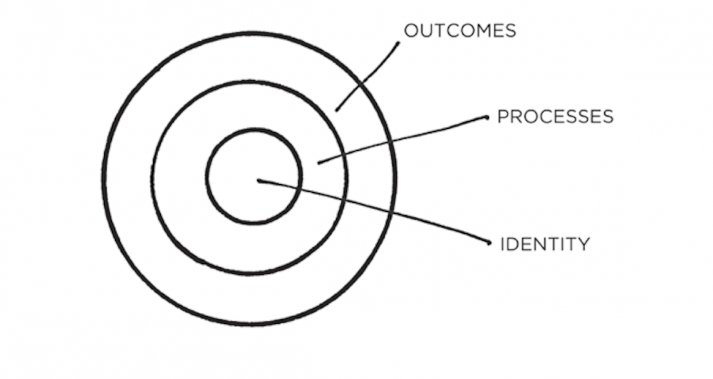
THE 3 LAYERS OF BEHAVIOR CHANGE:

The 1st layer is changing your outcomes. This level is concerned with changing your results: losing weight, publishing a book, winning a championship. Most of the goals you set are associated with this level of change.

The 2nd layer is changing your process. This level is concerned with changing your habits and systems: implementing a new routine at the gym, decluttering your desk for better workflow, developing a meditation practice. Most of the habits you build are associated with this level.

The 3rd and deepest layer is changing your identity. This level is concerned with changing your beliefs: your worldview, your self-image, your judgments about yourself and others. Most of the beliefs, assumptions, and biases you hold are associated with this level.

To put it more simply:

  • Outcomes are about what you get (“I lost weight”).
  • Processes are about what you do (“I go to the gym regularly”).
  • Identity is about what you believe (“I am a healthy person that never misses a workout.”

Now, none of the above is rocket science. I think anyway – I have never done rocket science. It’s the same thing we all do every time we try to change a habit.

The reason your habits never stick?

You’re implementing these layers BACKWARDS! Crap.

Where People Get Habit Change Wrong

Most people don’t consider the innermost layer – identity change – when they set out to improve.

We just think, “I want to be skinny (outcome) so if I stick to this diet, then I’ll be skinny (process).”

We set goals and determine the actions we should take to achieve those goals without considering the beliefs that drive our actions:

  • I want to lose weight, so if I go to the gym more, the scale will go down.
  • I want to fit into this bathing suit, so if I follow this crazy restrictive diet, I’ll reach my goal.
  • I want to run a 5k, so I’m gonna start training every day until I run it.

In each scenario, the person never shifts the way they look at themselves, and they don’t realize that their old identity can sabotage their new plans for change.

Let’s talk about identity (the innermost circle) for a second. 

When working for you, identity change can be a powerful force for self-improvement.

When working against you, though, identity change can be a curse:

“Once you have adopted an identity, it can be easy to let your allegiance to it impact your ability to change. Many people walk through life in a cognitive slumber, blindly following the norms attached to their identity.

When you have repeated a story to yourself for years (or decades), it is easy to slide into these mental grooves and accept them as a fact. In time, you begin to resist certain actions because “that’s not who I am.” There is internal pressure to maintain your self-image and behave in a way that is consistent with your beliefs.”

Whatever your identity is right now, you believe it because you have recurring proof:

  • If you identify as somebody with a slow metabolism – the high number on the scale reinforces that every day.
  • If you identify as somebody with no self control – the empty ice cream containers in your trash can reinforce that identity with each additional pint polished off.
  • If you identify as a victim of “too busy,” – then every day you are reminded of how busy you are and how you just don’t have time to take care of yourself.

It’s hard to change your habits if you never change the underlying beliefs that led to your past behavior.

You might have a new goal and a new plan, but you haven’t changed who you are.

This is the crucial step that everybody misses, and it’s something you can implement today.

Identity Based Habit Change: Middle Out For the Win!

True behavior change is identity change.

In other words, start with the inside circle and work your way outward. Here’s that graphic again:

You might start a habit because of motivation, but the only reason you’ll stick with one is that it becomes part of your identity:

“On any given day, you may struggle with your habits because you’re too busy or too tired or too overwhelmed or hundreds of other reasons. Over the long run, however, the real reason you fail to stick with habits is that your self-image gets in the way.

This is why you can’t get too attached to one version of your identity. Progress requires unlearning. Becoming the best version of yourself requires you to continuously edit your beliefs, and to upgrade and expand your identity.”

Anyone can convince themselves to visit the gym or eat healthy once or twice, but if you don’t shift the belief behind the behavior, then it is hard to stick with long-term changes.

In other words, improvements are only temporary until they become part of who you are:

  • The goal is not to run a marathon, the goal is to be a runner.
  • The goal is not to lose weight, the goal is to be a healthy self-confident person.
  • The goal is not to go to the gym, the goal is to be somebody that never misses a workout.

Can you see how this is VERY different than just “I’m gonna go on a diet to lose weight?” It’s MUCH deeper than that.

The person who incorporates exercise into their identity doesn’t have to convince themselves to train. Doing the right thing is easy. After all, when your behavior and your identity are fully aligned, you are no longer pursuing behavior change.

You are simply acting like the type of person you already believe yourself to be. This is the holy grail of permanent weight loss and health success.

Want to build a habit? Do these 2 Simple Steps.

If you’re going to build a new habit, it’s going to be a gradual evolution.

We change bit by bit, day by day, habit by habit. We are continually undergoing microevolutions of the self.

Each habit is like a suggestion:

“Hey, maybe this is who I am.” If you finish a book, then perhaps you ARE the type of person who likes reading. If you go to the gym, then perhaps you ARE the type of person who likes exercise.

And these are the two steps we’re going to hyper focus in on.

  • Decide the type of person you want to be.
  • Prove it to yourself with small wins.

STEP ONE: Decide who you want to be. This holds at any level— as an individual, as a team, as a community, as a nation. What do you want to stand for? What are your principles and values? Who do you wish to become?

We’ll get real nerdy on this step below.

STEP TWO: Once you have a handle on the type of person you want to be, take small steps to reinforce your desired identity. Each step, no matter how small, helps you start to realize that, maybe you CAN be a morning person. Or that you DON’T have a slow metabolism. Or that you ARE a runner!

Let’s dig deeper.

Rebel, What Is Your Profession?!

Depending on how long you’ve been reading Nerd Fitness, you might already be doing Step One.

For years now, Nerd Fitness has been turning life into a game. Depending on what you want your new identity to be, you pick the Class/Profession that lines up with this new identity.

You can even create a free character, and our uber-supportive Message Board community is segmented by these classes too. They’re also a big part of my book, Level Up Your Life.

Here are the 7 classes of Nerd Fitness. Pick the class that lines up with the way you WANT to train (longer descriptions here):

  • Warrior: strength training, powerlifting, olympic lifting, weights
  • Scout: running, swimming, biking, endurance
  • Adventurer: exploration, hiking, camping, climbing, travel excursions
  • Ranger: cross training, metabolic conditioning, jack of all trades
  • Assassin: parkour, gymnastics, bodyweight training, movement
  • Monk: martial arts
  • Druid: yoga, tai chi, meditation, nature

If you want to be a warrior, you ARE a Warrior. Inside. Right now. Welcome to the Warrior Guild!

If you want to run a marathon, congrats! You are a Scout. Inside. Right now. Welcome to the Scout’s Den!

If you want to lose weight and are considering joining a CrossFit gym, congrats! You’re a Ranger. Inside. Right now. Welcome to the Ranger Guild.

I don’t care if you are 400 pounds or 100 pounds and have never picked up a weight or ran a step in your life. Write out your alter-ego, the superhero version of yourself.

  • How do they train?
  • How do they eat?
  • What time do they go to bed?

The goal is not just weight loss – the goal is to build an identity that is aligned with the type of person you want to be.

Me personally? I am an Assassin in the Nerd Fitness Rebellion.

What is YOUR profession!?

Ask yourself this question all day, every day.

Congrats, you now have a new identity! It’s all unicorns and rainbows and effortless weight loss from here on out.

Kidding.

It’s still going to be hard work. There are no shortcuts. No temporary changes will create permanent results. Which means you need to change your perspective. It means you never get to be “done.” You don’t get to go on temporary diets.

Instead, you slowly shift your daily behavior, decision by decision.

And eventually, your outer evolution (lose weight, build muscle, physique change) is going to catch up to your new internal identity.

So now that you have created your new identity and picked your class, it’s time to start asking yourself the question whenever faced with a decision: “What would a Ranger/Monk/Scout do!?”

And then do that thing.

James had a friend who lost over 100 pounds by asking herself, “What would a healthy person do?”

All day long, she would use this question as a guide:

  • Would a healthy person walk or take a cab?
  • Would a healthy person order a burrito or a salad?

She figured if she acted like a healthy person long enough, eventually she would become that person. 100 pounds later, she was right.

So let’s look at our examples:

You don’t need to run a 5k to be a Scout. You decide you are a Scout today, and running for 5 seconds makes you a Scout. So what would a scout do? Skip their run? Or go for a run even though they only have 15 minutes?

You don’t need to have ever lifted a weight to be a Warrior. You can start acting like one now. Would a warrior sit on his butt and watch TV? Or would he be doing a beginner bodyweight workout?

You don’t need to be a gymnast NOW to be an Assassin. You just start acting like one. Would a healthy badass Assassin skip his handstand training today? Nope.

This stuff works. Ask yourself what a healthy/superhero/badass person would do. Just ASKING the question makes you more likely to change behavior.

As pointed out in the book Mindless Eating:

“We found we could get kids to choose the healthier food much more often if we simply asked what their favorite superhero or their favorite princess would do.

Even if they responded “french fries”, half the time they took the apple slices. It simply causes an interruption in their thinking that causes them to pause, hit the reset button inside their head and think again.”

In other words, asking “What would Batman do?” is a real thing, and it can fundamentally change the path of your journey.

Yup, even for adults. Whenever I think of skipping my workouts to play more videogames I always ask myself “What would Captain America do?”

More often than not, I end up in the gym. Because damnit, I am Captain America.

Make a small win today.

As the saying goes, “Big things have small beginnings.”

Do enough small things aligned with your new identity, and your outward appearance will start to reflect your new superhero identity.

Building better habits isn’t about littering your day with life hacks.

Your habits matter because they help you become the type of person you wish to be.

So I leave you with three questions:

  • What is your Profession!?
  • How would that person act today?
  • Can you get a small win today to reinforce that?

Here’s an example for each class to get you started:

What’s that? You want to build a certain physique? Start doing what those people do!

This is exactly what we preach and teach with our 1-on-1 Coaching Clients we essentially ask them what they want to be when they grow up (lol), and then create specific programs and help guide their food choices to become that new version of themselves!

Here is my answer:

“I am an Assassin in the Nerd Fitness Rebellion. I don’t care that I have thin wrists and crappy genetics. I’m reinforcing this by hitting the gym as soon as I hit publish on this article to work on my rings work. Tonight I will eat grilled chicken, quinoa, and broccoli.”

Your turn: Leave a comment below!

-Steve

PS: James Clear’s book Atomic Habits served as the inspiration and outline for today’s article – if you’re interested at all in bettering yourself and improving your health, I would highly recommend checking it out!


**All photo credits can be found right here[1]**


source https://www.nerdfitness.com/blog/most-people-go-about-habit-change-backwards-heres-how-to-flip-it/


Wednesday, 17 October 2018

The 20 Minute Beginner Kettlebell Workout: Build Muscle and Burn Fat

Everyone, at every fitness level, can use a kettlebell.

Yup, even you. And your mom. She’s cool.

When used properly, this funky piece of equipment can help you build muscle, burn fat, and feel like a badass.

Those are three great things in my book!

So you don’t have to be afraid of this cannonball with a handle. It’s not an actually explosive.

However, I can understand if you feel intimidated by a kettlebell. It’s awkward and if you don’t know how to use one, you’re just going to use it as a doorstop.

So fear not!

Team Nerd Fitness has designed a kettlebell workout specifically for beginners that you can do TODAY.

The routine will help build muscle and burn fat, two key components of any exercise program. We’ll also make sure you know how to handle a kettlebell safely and effectively. If you couple this with a solid nutrition plan (don’t worry, I got you covered here too), you’ll have a great strategy for many different fitness goals.

So let’s rap about the following:

  • What kettlebell workout you should start with.
  • Why kettlebells are great.
  • Mistakes with the kettlebell we want to make sure you avoid.
  • If you want to purchase one, what kettlebell you should get.

Let’s go! Once you watch the video below, feel free to download our Beginner Kettlebell Worksheet that you can print out and use when you do your next workout! You can get yours free when you sign up in the box below:

The 20 Minute Beginner Kettlebell Workout

Our Beginner Kettlebell Workout is what’s called a circuit (you can learn all about circuit training here)

That’s just a fancy term for doing a workout like so:

  • 1 set of exercise A, go immediately to
  • 1 set of exercise B, go immediately to
  • 1 set of exercise C
  • Repeat from the top!

Your long term goal should be to do 3 full circuits back to back for a complete workout. Four if you’re in Berserker mode. If you can only go through it once or twice, that’s A-OK.

And if you need to take a break at any time between sets or after a circuit, do it! You do you.

Prior to jumping into the kettlebell circuit, don’t forget to do some mobility warm up (you can see our warm-up routine here).

Nothing too crazy, just something to “grease the groove” and get your body used to movement so you don’t pull any muscles once you start swinging the kettlebell. In other words, preparing your muscles and joints to move some weight around! Five minutes of running in place, air punches and kicks, some jumping jacks and arm swings, should get your heart rate up and your muscles warmed.

Then you’re ready for the Beginner Kettlebell Workout!

Once you’ve watched the video, here’s a quick recap with repetitions for the workout here:

COMPLETE THE FOLLOWING CIRCUIT 3 TIMES:

  • 8 Halos (each side)
  • 10 Goblet Squats
  • 8 Overhead Presses (each side)
  • 15 Kettlebell Swings
  • 8 Bent Over Rows (each side)
  • 6 Front Rack Reverse Lunge (per side)

You can do all of the above with one single kettlebell, from anywhere. Some things to keep in mind during the routine.

  • With your halos, remember to keep the movement smooth. You don’t want to accidentally slam your head with the bell.
  • For the goblet squat, focus on depth. It’s more important to practice doing a full squat than to pump out reps. If you can’t make 10, don’t stress it. Do what you can.
  • When doing the overhead press, get tight. Tightening your muscles will engage your core, offering a fuller body workout.
  • During the kettlebell swing, focus on hinging your hips. The swing is like a deadlift movement, so you should feel it in your hamstring and glutes.
  • Try to keep your back straight and stomach tight during the row. This will help engage your legs for stabilization as you pull the kettlebell towards your stomach.
  • For the lunges, again keep your back straight. By keeping your shoulders back, you’ll get a fuller body workout when you come in and out of your lunge.

When you’re done, do some light stretching to cool down. A couple yoga poses would suffice. Make sure you drink water too.

Feel free to go through this routine at least once a week, and up to 2-3 times a week, with a day off between. Remember, you don’t build muscle when you’re exercising, you build muscle when you’re resting. Your muscles are broken down when you strength train, and then they rebuild themselves stronger over the following days of recovery! If you just can’t sit still, feel free to do some fun exercises, go for a walk, or do one of the following.

If you read all of the above and you’re intimidated or overwhelmed, I totally get it.

I personally know how scary it can be to embark on a strength training program, especially when you don’t know if you’re doing it correctly. My first time lifting weights was a nightmare.

The results are worth it though, I promise.

Want help on this journey? We got you! We have an online coaching program if you still feel apprehensive about lifting weights, or worried about your proper form on these movements. Matt S from the video above is part of the Nerd Fitness Team that offers private 1-on-1 coaching to help you get in shape. Whatever your goals are, we will build a program that’s specific to your hectic life!

If you want to learn more, click on the big button below to schedule a free call with our team to learn more and see if we’re a good fit for each other!

In case you’re still on the fence about grabbing a kettlebell, let’s dig into them a little bit more [1].

Which Kettlebell Should I Buy? What are the best Kettlebell Brands?

So you want to buy a kettlebell, eh?

They come in all sorts of materials, in all sorts of shapes, and in all sorts of sizes. Which one you pick will come down to personal preference, your budget, and your experience with kettlebells.

Let’s contemplate the following:

  • Standard vs.Competition. A standard traditional kettlebell will be cast iron, and as the weight goes up, the dimensions go up. For example, a 16kg (35 lb.) bell will be larger than a 6kg (15lb) bell. This isn’t true for competitive kettlebells. No matter their weight, competitive kettlebells will have the same dimensions for bell shape, base, and handle width. So the 16kg will look just like the 6kg. This can be helpful to make sure you are consistent with technique.
  • Weight. In general, pick a weight that allows you to complete a workout with good form. When in doubt, start with a lighter weight, as you can always increase the weight/size later. If you’re forcing me to pick one for you, knowing NOTHING about you, I’d say consider purchasing a 16kg if you’re a male or 8kg if you’re a female. Now, this isn’t an exact science, and we are all unique snowflakes. If you think you’re stronger than average, go heavier. Not quite there? Go lighter.
  • Ballistic vs. Grind. You’ll often hear the terms ballistic and grinding in kettlebell workout discussions, for fast and slow movements respectively. Ballistic movements would be quick, like the kettlebell swing. Grinding movements would be slow, like the overhead press. For ballistic movements, you might actually want a heavier kettlebell, to help with momentum. For grinding movements, less weight might be in order to help with control. For now, if you are just starting out, go ahead and stick to one kettlebell. Branch out as you advance in experience.
  • Handle. This is where quality comes into play. You’ll be doing many, many repetitions with your kettlebell. If the handle has rough edges, you’ll feel each and everyone of the movements scrap into your hand. Ouch. Not fun. Quality matters when it comes to handles. So we’ll chat about ideal brands in a moment. I’ll end our discussion on handles by saying they are generally standardized at 35mm for thickness. Use this as your baseline for differences when comparing bell grips.

Okay, let’s talk about brands:

  • Cap Barbell. This would be an ideal first kettlebell. Not too expensive and decent quality, Cap Barbell kettlebells can be found on Amazon or at any Walmart. The Cap Barbell is the most highly reviewed and reasonably priced kettlebell we have encountered. Do you have any experience with one? Let us know in the comments if you like it!
  • Kettlebell Kings. You see Kettlebell Kings ranked as some of the best bells out there. Not a bad price for the quality. Plus, they offer free shipping in the US, which is nice since you’re essentially mailing a cannonball.
  • Dragon Door. Some call Dragon Door the gold standard of anything and everything “kettlebell.” I wouldn’t disagree, but expect to pay for it.
  • Onnit. Onnit rocks, and they offer good quality bells that are quite popular. And… they sell a Darth Vader one. I know, I should have started with that.

OUR ADVICE: Before you go buy an expensive kettlebell, check your gym! I bet it has kettlebells, and you can try out different brands/sizes/weights/styles to see which one you like the best.

Afraid of going to the gym? I got you.

Don’t care about buying your bell new? Check out Craigslist or a used sporting goods store like Play it Again Sports for a previously owned kettlebell from a person who no longer needs it. A used kettlebell is still a kettlebell.

Crafty? Build your own! Here’s a video on how to make a kettlebell:

If you make your own kettlebell (be careful – you don’t want it breaking mid swing!), please email me. I would be so pumped!

How to Lose Weight with A Kettlebell Workout Program

If you’re trying to get fit, a kettlebell and the workout routine above would be a great part of the plan!

The other part of the plan should be your nutrition.

As we lay out in our Coaching Program and our online Nerd Fitness Academy, we believe that proper nutrition is 80-90% of the equation for weight loss.

No joke. It’s by far the biggest factor for success.

So will you lose weight training with kettlebells? Maybe. If you fix your diet AND begin to incorporate our kettlebell routine a few times per week, you’ll will find yourself building muscle, losing fat, and getting stronger!

So how do you fix your diet?

Great question.

Whether you choose to follow a Keto Diet, Paleo Diet, Mediterranean Diet, or something like Intermittent Fasting, the best path will be up to your goals, your situation, and your habits.

Here are some basic tips though (as we cover in our Beginner’s Guide to Healthy Eating):

  • If your goal is weight loss, you have to eat less than you burn each day. This can be through eating less and burning more (from the kettlebell workout above)
  • Processed foods and junk food makes it really tough to lose weight: They have lots of calories and carbs, low nutritional value, don’t fill you up, and cause you to overeat.
  • Vegetables are your friend. If you don’t like veggies, here’s our advice on how to fix that.
  • Liquid calories are making you fat. Soda, juice, sports drinks: they’re all pretty much high calorie sugar water with minimal nutritional value. Get your caffeine from black coffee or tea, fizzy-drink fix from sparking water.
  • Not losing weight? Track your calories and work on consuming slightly less each day.
  • Eat more protein! Protein helps rebuild muscle, and can help you stay under your calorie limit because it’s satiating and filling.

If you’re not quite sure how to eat correctly, we created a created a free 10-level nutrition blueprint that helps you build better food habits. You can download yours free by clicking in the box below:

Do Your First Kettlebell Workout TODAY

Like most things in life, the important aspect of any exercise regimen is starting it.

No matter what strength training program you choose, start TODAY. You don’t need to get strong before you can play with a kettlebell. You can play with a kettlebell to get stronger!

Here’s that Beginner Kettlebell Workout one more time to recap:

  • 8 Halos (each side)
  • 10 Goblet Squats
  • 8 Overhead Presses (each side)
  • 15 Kettlebell Swings
  • 8 Bent Over Rows (each side)
  • 6 Front Rack Reverse Lunge (per side)

I’d love for you to start with your new strength training today, and let us know how things go with your kettlebell!

If you want help through any part of the fitness spectrum, I’ll remind you of the Nerd Fitness 1-on-1 Online Coaching program. Our coaches can work with you to pick up a kettlebell for the first time or to learn more advance moves.

Whether you are brand new to your fitness journey, or ready to take it to the next level, we have your back!

If you want to go another route, like strictly bodyweight workouts, that’s great too. It’ll help a lot. Just start moving!

-Steve

PS. Don’t forget to download our Beginner Kettlebell Worksheet – and let us know what you think of it!

*All photo sources can be found in this footnote right here[2]


source https://www.nerdfitness.com/blog/the-20-minute-beginner-kettlebell-workout-build-muscle-and-burn-fat/

Wednesday, 10 October 2018

How Joe the Lawyer Lost 50 Pounds, Ran a Half-Marathon, and Got Engaged!

Talk about a life level up!

Meet Joe, an attorney from Minnesota who has been reading Nerd Fitness for the past 5-6 years. He attempted to get in shape 6-8 times in that span with various levels of temporary success, only to give back all of his progress each time.

However, over the past 10 months, Joe has become a man possessed – in a good way.

He’s gone from not being able to run for 60 seconds and plowing through fast food to losing 50 pounds, running a half-marathon on trails, passing the bar exam, and even getting engaged!

I LOVE Joe’s new mentality, and the insight he shared with me about all of the things that he surprised himself with since he began his this transformative journey.

I’m proud to say that Joe has been in our 1-on-1 Online Coaching program since January, and I’d love for you to check it out to see if it’s the right fit for you (and beat the January rush – we expect a long waiting list by then).

So why is today’s article is so important?

Because it was some brutal realizations and a specific decision that Joe made around this time last year that made him realize something needed to change!

I want you to be honest with yourself: It’s almost November. Are you 80+% of the way towards the goals you set for yourself back in January? Or are you already saying, “Meh, 2018 is a lost cause. I’ll try again next year.”

No! Wrong! Full stop!

There are still 2.5 months left in the year!

If you fell off the wagon or got stuck or never got started, Joe’s story will resonate with you.

Below, I’ll share Joe’s insights and lessons learned along with the way, along with key steps you can take starting today to break out of a rut and level up!

Go Joe!

How Joe the Lawyer Lost 50 Pounds AND Leveled Up His Life

STEVE: Hey Joe! Thank you so much for taking the time to chat with me – I’d love to hear from you about your past – how many times had you tried to get in shape before this most recent success?

JOE: I had tried to lose weight at least eight times.

Every single time, I tried it on my own because I think I felt like, “If I can’t do this on my own, then what’s the point?”

Here are the most memorable:

Attempt #1: I wasn’t particularly overweight back in college, but I felt like I should try to be more careful about what I ate. I tried calorie counting by itself, but that led to extreme dieting on my part.

Attempt #2: I tried doing the Paleo Diet and lost weight rapidly, only to put all the weight back on immediately after I stopped because I couldn’t maintain eating so little each day.

Attempt #3:  I tried to force myself into running by waking up one morning and going for a two-mile run; obviously I didn’t make it, and I just felt so damn dejected afterwards that I struggled to do anything.

Attempt #4: I re-tried the running approach (starting smaller), and it actually worked…for about two weeks. I was running a bit each day, and I started feeling the positive effects. In the long run (pun intended?), however, I just got tired and had nothing really pushing me to keep going, so I stopped.

Attempt #5: When I tried picking up weightlifting, I planned out three weeks of workouts, and generally did them. But after those three workouts, I didn’t plan out any more workouts and I just stopped again.

Following that, I started a long build-up of weight gain and unhealthy habits. As a law student, I had long hours of class and many hours of homework in the evenings. When I needed to go get food, I would eat at restaurants like Subway, Leeann Chin, or other fast food.

This eventually resulted in me reaching my heaviest weight ever right around December 2017.

STEVE: Okay so fast forward to this past fall. You had been reading Nerd Fitness for 5 years, why did you finally take action?

JOE: Overall, in the past I think I lacked motivation for a few reasons:

  • I didn’t have any real drive to change myself.
  • I thought that if I couldn’t do things on my own, I was a failure as a person.

Three things pushed me over the edge, and specifically towards Nerd Fitness’s one-on-one coaching.

The first thing was my “wake up” moment:

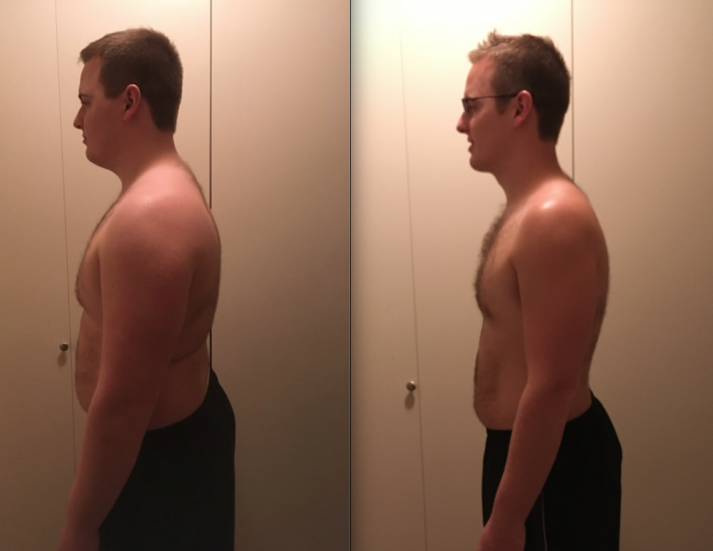
Over Christmas break in my last year of law school (December 2017 – pictured), I was on vacation participating in one of my hobbies–scuba diving.
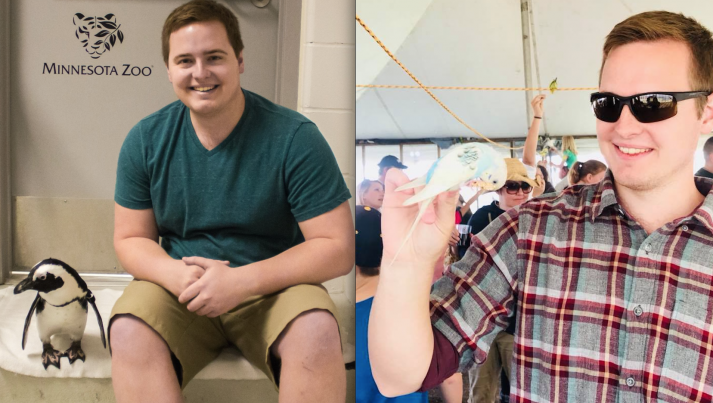

While underwater, I went through my air tank almost 40% faster than everyone else I was diving with. In other words, I had to surface WAY BEFORE everyone else and I was just sitting on the surface waiting.

Alone.

I had let myself get to the point where I could no longer do the things I wanted to do.

I couldn’t ignore my weight gain anymore. I knew something had to change or else I wasn’t going to be happy moving forward.

The second thing was an email from you, Steve.

I had been on the Nerd Fitness email list for years because I had been following the website for awhile. I didn’t really do anything serious due to the issues I listed above.

Right around Christmas, you sent out an email talking about how it was likely that many people reading the email had not made a real change — that they had not followed through on their “New Year Resolutions—and may be in an even worse position than they were at the beginning of the prior year.”

I realized that was me. I hadn’t changed.

I hadn’t really even tried to change, even though I knew I should have. And that email re-oriented me to thinking about HOW I could change.

STEVE: I remember writing that email, because I almost didn’t send it! However, we’re a site dedicated to helping people, and oftentimes that requires tough love. I’m glad that message resonated with you.

So what made you decide to try out NF Coaching? What pushed you over the edge to make the investment?

JOE: I figured that my problem might be motivation and accountability (see above).

I also knew I trusted the Nerd Fitness website because I had been receiving emails from you for years.

Never once did you try to sell me a “quick fix” or a “get in shape fast” program.

You never suggested that losing weight would be unrealistically simple or easy; you were always down to earth about the fact that it takes time and focus. I liked that. It felt like a non-BS approach.

So I decided to schedule a free call to learn about the program and ended up signing up!

STEVE: That’s great man. If I remember correctly I was actually the one who spoke with you on the phone! And I know you’ve been working with Staci as your coach for the past 10 months.

What’s a typical day like for you NOW, after the changes?

JOE: I still sit a lot, but now I’m aware of it. As an attorney, you spend a lot of time in an office doing a lot of reading, researching, and writing. So now I get up a lot more, take a quick spin around the office and say hi to coworkers.

Some days, depending on the weather (and even in the cold!) I will go for a run over the lunch hour to get my workout done earlier in the day.

It’s not necessarily that day-to-day activities have necessarily changed that much; it’s more like I’m aware of what those activities really are, and try to mix up them up whenever I can.

STEVE: Tell me about the workout program Staci built for you. 

JOE: I live in an apartment complex with a small gym; that helped a lot – (though given what Coach Staci has set up, I don’t think a gym is even necessary half the time).

Because I had the gym, most of my workouts were bodyweight and free-weight (dumbbell) exercises. Staci also worked in cardio on days between strength training. Also, I can’t stress this enough: she started with manageable workouts and slowly built up. My first “workout” in the program? A five-minute walk.

Now I can run 30x as long.

On the running, Staci was a huge help. Back in March, I told her about a 5K race in July that I had tried and failed to run in the past. In fact, I hurt myself pretty bad because again I was trying to do too much all at once.

I told her that I wanted to slowly build up to it, so she started changing my then-30 minute walks into “run 1 minute, walk three minute” cycles. Over time, she helped me build up muscle and endurance. I crushed the 5k, completing it faster than I had ever run anything in my life.

That helped me understand what I could be capable of.

Two and half weeks later, I ran a 10K.

Just this past Saturday, I ran a half marathon on trails in a giant park near where I live because after all this time I felt like trying to see how far I could run.

I cannot believe that in ten months, I went from being unable to run for a full minute to running for over two hours on hills and trails. I honestly don’t think I would have ever reached where I am now without Staci’s constant encouragement and guidance.

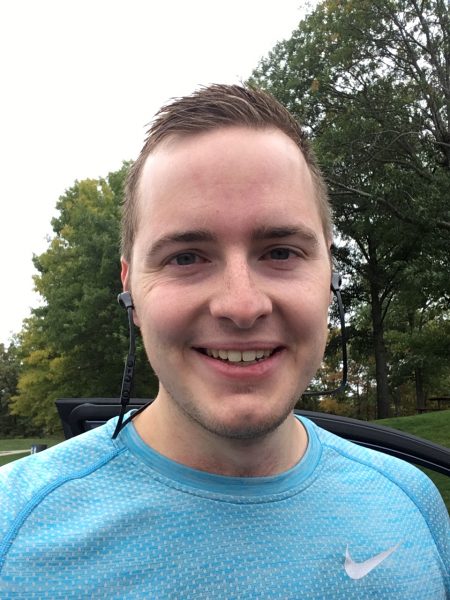
Here’s a picture of me right after that run, look how happy I am!

STEVE: I love this so much. Congratulations on the success so far, man. Talk to us about your nutrition! We know here in NF that nutrition is 80% of the equation.

JOE: This was the hardest part for me, because I was eating like I was a kid: fast food, sweets, etc.

When I did cook, it was simple things that often had loads of fat (i.e. five grilled cheese sandwiches in one sitting, with dessert).

I was also really hesitant to do the Paleo diet, or try something like the Keto diet, or Mediterranean, or calorie counting again because, as I mentioned before, some of these methods hadn’t really worked for me in the past.

Staci helped me by providing basic advice on eating healthy – diagrams of ideal “plates” of food for dinner (with portion sizing).

To avoid calorie counting, she had me send her pictures of everything I was eating through the Nerd Fitness Coaching App, which really enhanced the accountability aspect of eating healthy because I didn’t hyper-focus on my food.

Over time, my habits slowly adjusted to become healthier. I also have my now-fiancé to thank for being extremely supportive in helping me eat healthy.

I eventually transitioned to using MyFitnessPal to count calories after I started seeing results because I wanted to understand more about my food choices. That helped a lot.

Training has taught me that eating healthier leaves me feeling better overall. It literally made it easier to say no to bad options, and choose healthier options.

For example, I no longer drink coffee with cream or sugar. When stopping at gas stations on the road, I buy a banana and a string cheese stick if I’m hungry. Small changes.

STEVE: What was the most important change you think you made?

JOE: Doing something, and admitting to myself that I needed help on what to do.

I wanted to change so badly, but I just kept failing.

It got to the point where my family sort of anticipated the fact that I probably wouldn’t maintain my attempts at weight loss.

I knew I had to do something, and this program ended up working out beautifully.

STEVE: Your physical appearance has changed…what else has changed about you? You got engaged!

JOE: I did get engaged – very recently! That has been an extremely welcome change, as has the physical appearance differences.

More than anything, I feel… light.

When people suggest walking from one place to another, I don’t worry about it.

When someone suggests going hiking, I am up for it.

When my family wants to do a project, I know that physically I won’t have any problems.

Overall, my mental attitude about what I can do has changed immensely. Also, as I told you at the beginning Steve, I wanted to look good in a suit. Now I think I look pretty damn good in a suit.

The speakers line at 4:25­—“Accept where you are, and the responsibility that you are gonna take yourself where you want to go”—has become a bit of a mantra for me.

I had to accept where I was in terms of weight gain, and shoulder the responsibility, with Staci’s help, of getting to a different place.

STEVE: What are your goals moving forward? What kind of awesomeness do you want to do in your new body?

JOE: I want to run a marathon: 26.2 miles.

I have always had that as a long term goal, but I’m realizing that it may be within my grasp a bit sooner than expected.

I would also like a six pack, but hey… that takes time haha.

I’ve noticed a few opportunities online to run some races in national parks, so I’ve looked at those too.

One thing you will notice when you run a lot is that you tend to want to change up the scenery a little bit; running through Grand Teton National Park sounds pretty amazing, and there are some companies that organize relatively inexpensive races in those areas for runners interested in mixing it up.

I would like to explore those options.

STEVE: What makes NF Coaching a worthy investment for you each month? I know it’s a big investment, and many would just be “done,” but you’re here 10 months later – and counting! 

JOE: The 1-on-1 coaching program plans out long-term change for me—the workouts, the habit changes, the healthy eating—so that all I have to focus on is doing it.

And yup, the “doing” part certainly isn’t easy…

But when someone is encouraging you, guiding you, texting you regularly, and helping you understand how to integrate healthy changes into your own unique lifestyle and day-to-day activities, actually DOING the program becomes much easier than you would think.

Every single time I do a workout, I get better.

Every time I eat healthy, I can feel a difference (even if its very slight).

Because of that, I don’t sweat the cost because I know that the money I would have been spending on unhealthy habits like fast food, eating out, and sweets is going towards making me a happier, healthier person.

Plus, the whole Nerd Fitness team is amazing:

I have spoken with several individuals on the team (whether through the phone or over the internet) and I can’t stress enough that they want you to make it. They actually care if you succeed.

Yes, NF is a business. Yes, Team Nerd Fitness has to make money to function.

But I’ve never seen a fitness company so oriented around its clients like this one.

On a simpler note, the results speak for themselves: I have almost hit 50lbs of weight loss. Clearly, the Nerd Fitness approach works.

And you know what the best part is? Every time I eat healthier or do a workout, I feel good about it.

There is no regret, no exasperation, and no sense of boredom or repetitiveness.

The coaches are good about teaching you healthy habits and principles to the point where you want to do them simply because they work for you, and you feel better because of them.

Steve: Damn dude, I can’t tell you how good that makes me feel about the team we’ve built. Thank you.

Do you have any words of advice for people reading this who are at where you were last fall? What can you say to those people to help themselves make changes?

Joe: Accept where you are right now, on Day One. You can’t change it, but it’s a starting point. And then take responsibility for where you want to go.

I was overweight, obese, dejected, upset, and worried about my relationship. But every single day I did something (whether eating healthy, working out, or both), the struggle became a little easier.

As that video I reference above says, “Accept where you are and the responsibility that you are gonna take yourself where you want to go.”

As long as I was working on making myself stronger, faster, and healthier, then I could accept where I am now.

I know it’s cliche, but don’t give up. Know that even if I don’t know who you are, or where you are, I am right there with you. We all are right there with you.

Steve: What would you say to somebody who is interested but unsure about trying Nerd Fitness Coaching?

Joe: What do you have to lose?

Seriously!

Don’t just read that and move on. Stop and think about it.

My guess is you said time, money, or some variation of “lost hope” if it doesn’t work.

  • Regarding time, all this program is going to do is add time to your life. And any time you “lose” working out is probably better spent doing the workouts, at least for long term health.
  • With respect to money, if you are anything like I was at the start of the program, my guess is you probably are already spending the money that it would cost for this program on fast food and other unhealthy habits during the month anyway.

Would you rather change your life, or have one more fast food meal?

If you are worried about losing hope or motivation for a change, do the program and TALK TO YOUR COACH. They are there to keep your drive alive, and to help you understand that the time and energy required to see change is manageable.

You can cancel at anytime, although I don’t want to.

At the end of the day, what do you have to lose?

On the flip side, just imagine how good you will feel if it works? If you can commit and change your life?

Take the time to “accept where you are” and shoulder the responsibility necessary to make that change for the better. Everyone at Nerd Fitness believes you can do it. I believe you can do it. The only person standing in your way is you.

I know my answers to some of these questions may seem long, but if it results in even one person changing their life like I have, I’ll be happy.

Steve: Joe, can I hire you as Nerd Fitness’s hype person? Ha! Seriously though, thank you for sharing these answers with the NF Rebellion

The 5 Keys to Joe’s Weight Loss and Level Up Success!

I’ve been following Joe’s story for the past 10 months, getting regular updates from his coach Staci, and I tried to distill his success down into a few bite-sized words of wisdom you can take with you today:

#1 JOE NEVER GAVE UP

This is a dude who’s been reading Nerd Fitness emails for 5 years! He tried calorie counting. He tried Paleo. He tried running. He tried weight lifting. Nothing stuck.

Joe finally found a good enough reason to change his life: he was unable to do the activities he wanted to do because of his weight, and something needed to change.

Thank goodness Joe stayed a part of Nerd Fitness for years until the right message hit him at the right time in his life, and he was ready to take action.

You’re here reading this, which means no matter where you’re at and how far off the wagon you’ve fallen, you’re reading this and that’s amazing. Thank you for being here!

Even if you failed 100 times getting in shape in the past, the right message hasn’t hit you at the right time. Keep trying. Keep reading. Maybe today can be the spark that lights the fire for YOUR story – that I can share next year 🙂

#2 JOE GAVE HIMSELF PERMISSION TO SEEK HELP

I can relate so much to Joe’s previous mentality, and I bet you can too: “I didn’t realize that asking for help was okay.” I too spent a decade training myself because I thought it would make me less of a person if I needed somebody’s help to succeed.

It wasn’t until I realized that the best athletes and top performers on the planet have coaches too – and that’s the same conclusion Joe came to.

Not only is asking for help smart, not only is hiring a coach wise, but for many (myself, Joe, and for most people), having guidance and accountability is the difference between “Holy crap my life is completely different” success, and “oh man, where did the year go? Another year of not succeeding” failure.

Having a coach doesn’t make you weak. It makes you smart.

#3 JOE FOUND EXERCISE THAT EXCITED HIM

Although Joe had tried running and strength training in the past, neither stuck.

It wasn’t until this recent attempt that he gave running another chance, and with the proper motivation, accountability, guidance, and a plan built for his life that it actually stuck. You have the find the exercise that works for you – or it won’t stick.

I asked Joe what the old Joe would be surprised to learn about the New Joe:

“Apparently, I like running. The old me would have laughed at that idea. If I told the old me that I ran for two and half hours last Saturday, I’m sure the old me would have called bullcrap and got up and left. But it’s true. You never know what you are capable of until you try.”

#4 JOE HAD SKIN IN THE GAME

This was Joe’s 9th attempt (at least) at getting in shape. He had tried strict dieting and going ALL IN multiple times in the past.

He had tried building his own workout programs and creating his own running routines – he did all of this for free, and I’m not surprised that the results didn’t last.

Why? Because he didn’t have any skin in the game! Simply put: we value what we spend our money on, and we don’t value what we get for free.

On this effort, Joe had tried the “Do it Myself” path for YEARS and failed, so this time he knew he would have to try a different approach.

Joe had invested his hard earned money in his health with coaching, so he actually took this attempt seriously.

How are you investing in yourself? Coaching, a gym membership, investing more in higher quality food, or even just investing your time into research if money is tight!

But you are worth the investment!

#5 JOE IS ENJOYING HIS JOURNEY

This is a lifelong journey.

You can’t expect to go on a diet for a few weeks or months to reach a goal weight and then go “back to normal.” Temporary changes equal temporary results.

If you never get to be “done,” you better enjoy the journey, right?

Notice the wording Joe uses above: “

So if you are gonna get in shape, focus on the process. As we say in NF: focus on days and years, not weeks and months. Just do the thing today that needs to get done:

Where Will You Be 10 Months from Now? Don’t Wait Until January!

If you’re still reading this, I want you to know I’m damn proud of you for even trying. I’m thankful you’re in our little community here on the internet, and I’m quite excited for your future.

Not only that, but I’m proud of you for what you’re going to do today.

MOST people have already given up on 2018. They’re going to dig themselves into a deeper, bigger hole over the next 2.5 months, and they’re going to wake up in January 50 yards farther away from the starting line than they are today.

BUT NOT YOU!

Why?

Because you’re gonna be like Joe:

  • Never give up. Keep reading. Keep trying. But try something DIFFERENT this time. Don’t do the same thing you did the last time. Don’t just “try to lose weight” and “go on a diet.” Be deliberate in your attempt!
  • Give yourself permission to seek help. Whether it’s coaching or asking somebody who has lost weight in the way you want to, ask them for guidance! I’ve been working with a coach myself for 4+ years now!
  • Find the exercise that works for you. It might be running. Or hiking. Or strength training. If you don’t enjoy it, don’t do it!
  • Have some skin in the game. You don’t value things you get for free nearly as much as things that you spent your hard earned money on! Invest in yourself!
  • Enjoy the journey. You don’t get to be done,

And today, you’re gonna do literally ANYTHING:

Go for a 5 minute walk. That was Joe’s first workout in the NF Coaching program. 10 months later he’s down 50 pounds and running trail half-marathons and EXCITED ABOUT IT.

Try our Beginner Bodyweight Workout.

Eat a vegetable. Yes, even if you hate them.

If you’re interested in being coached and having a program built for your exact situation, we’d love to chat with ya. 

Like we did we Joe, we speak with everybody on the phone that is interested in the coaching program – we want to know people’s stories, learn about their struggles, and then decide together if our program can help!

If you want professional guidance, a custom built workout program tailored to your specific goals, and expert accountability and motivation from Team NF, schedule a call with our team by clicking in the box below:

To wrap it all up:

Start.

Today.

Don’t wait until January. Don’t “go on hold” during the Holidays – this is when everybody messes up and loses all their gains from the previous 10 months.

Get the habits and start small now, and then you’ll have routine and momentum down pat come January! I want to hear from you:

What’s the ONE thing you’re going to do today?

Me: I’m gonna hit the gym and work on my deadlifts!

-Steve

###


source https://www.nerdfitness.com/blog/how-joe-the-lawyer-lost-50-pounds-ran-a-half-marathon-and-got-engaged/

Monday, 8 October 2018

How to Use A Foam Roller: Step-by-Step Guide

In the last few years, the foam roller has become a staple in commercial gyms. 10% of every piece of equipment in a modern fitness facility is now some type of foam roller.

Not true, but they are indeed everywhere.

And with good reason: you can essentially give yourself a deep tissue massage with one of these bad boys. And if you fork out $20 bucks, you don’t even have to leave your home to do it!

So today we’ll chat about these new toys:

  • The benefits of using a foam roller
  • Some simple exercises you can do from home
  • Common pitfalls we want to make sure you avoid
  • What to buy should you want one
  • Whether or not you should put a cat in one

That last one is definitely a hard “no.”

Let’s get rolling (the puns are only going to get worse from here)

What are the benefits of using a foam roller?

You’ll often hear using a foam roller as “self-myofascial release.”

You may be asking, “myofawhatnow?”

Don’t stress, because “fascia” is just the connective tissue covering muscle. Just know that “self-myofascial release” means giving yourself a tissue massage.

The type of massage you receive has a lot to do with the type of roller you use and the exercises performed. For example, the denser and firmer the roller, the more intense the massage will be. Think the difference between the relaxing touch of a masseur/masseuse and a deep tissue sports massage where you cry out in agony but feel great after.

We’ll start you off with the more relaxing sequence.

Now, it should be noted there is a debate on the actual benefits of “self-myofascial release.” There are some claims that myofascial release will help flexibility and muscle recovery. There are others that say that’s bogus.

What does the science say?

Some of it’s supported:

  • A foam roller has been shown to help the range of hip motion in soccer players[1].
  • Rolling massages can help alleviate muscle soreness[2].

Some of it is not supported:

  • Foam rolling use doesn’t appear to impact the length of muscle[3].
  • A study found no help in relieving “tightness” in the hamstring[4].

So yeah, the science isn’t definitive on this. But there does seem to be a lot of anecdotal evidence praising foam rollers.

My take? I think the foam roller is a great tool for temporary pain relief as long as it’s used correctly, but you can’t ignore what caused the soreness in the first place!

Want help getting started?

Beginner foam roller exercises

All you need is some type of roller and some floor space. A yoga mat would be helpful but not required.

We’ll go over four simple exercises to get you going with a foam roller. Think of the following as a relaxing sequence:

  • Thoracic Spine
  • Glutes (both sides)
  • Quads (one at a time)
  • Abductors

Take each move for about 20-30 seconds. Hold for major sore spots. Breath deeply, calmly.

I asked Matt Myers, one of our online coaches at Nerd Fitness – he’s hilarious but don’t tell him I said that – to guide you through these moves in this quick video.

Yes, that’s a T-Rex on a foam roller. You’re welcome:

That’s it. Keep it simple at first.

You can do this sequence after a workout. Or even before. Or all by itself. Go wild.

Common mistakes when using a foam roller

I want to make an important point on foam rollers:

As mentioned, one of the benefits is their ability to help with painful or tight areas.

However, it’s important to remember that using a foam roller won’t treat the root cause of the pain. It’s only going to help  treat the symptom by easing pain.

As the studies above point out, it’s not quite clear how myofascial release does this.

What I’m trying to say: If you’re working out incorrectly, or in pain because of a sedentary lifestyle, or some other type of issue, using a foam roller won’t fix it. It’ll only help you manage the discomfort. You’ll potentially need outside help to uncover the real issue that’s causing the problem in the first place.

The foam roller is the equivalent of using painkillers to help a broken foot, without first setting any of the bones correctly, or asking the question “Why did you think kicking that brick wall was a good idea in the first place?”

Eek.

So use the foam roller to manage discomfort, but know that it’s not a panacea (boy do I love that word) for all of your ailments and movement issues!

If you’re not sure if you are training correctly, or you’re struggling to not always be dealing with pulled or sore muscles, we are here to help. Matt from our video above, is part of the experienced, fun, non-judgmental staff that make up the Nerd Fitness 1-on-1 Online Coaching Program. Our team can help with many different types of exercises, with or without a roller. Plus, if you’re struggling with weight loss, they can help there too.

Want to see if we are a good fit for each other? Click on the big image below to schedule a free consultation with our Team (you’ll probably speak with Big Red, he’s good people):

Foam roller recommendations

You now know a foam roller can be a super helpful tool to manage pain and discomfort. And thanks to Matt, you even know how to use one.

Want to buy one? You need to think about the following:

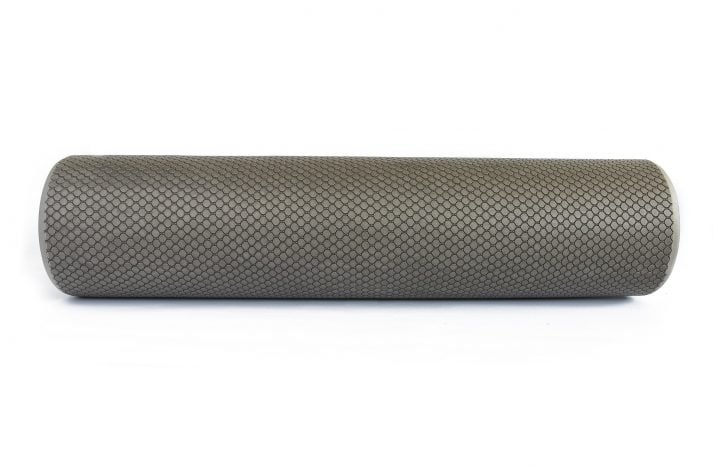
  • Density: the denser the roller, the more intense the massage you’ll receive.
  • Texture: some rollers will have ridges and knots to help dig into your muscle and tissue.
  • Shape and size: big ones, small ones, some as big as your head. You can get a foam roller in just about every size you could want.

There’s a lot to consider, but here’s some solid choices:

Boom. That’ll give you some options to… get rolling.

In appreciation of self care

Our lives are busy. It can be a real challenge to carve out time to take care of ourselves. But it’s important that we do. Outside of anyone else, we are in the best position to help ourselves (duh). Even if it’s only for five minutes and with a piece of foam.

Foam rolling is a great way to manage tightness and pain from the comfort of your own home. If you don’t have one, you can also use household items like a tennis ball to attack the “knots” that develop in our bodies. Or, go the other way and spring for a licensed massage[5].

The importance is self care. Try the foam roller the next time you’re at the gym. Or get one sent to your home. It’s a fun toy to have around.

Breathe in now, breathe out, and as Fred Durst of Limp Bizkit taught us: “just keep rollin’ baby.”

What do you think? Love foam rollers? Or think they are a tripping hazard at the gym? Want more advanced exercises? Let us know!

-Steve

PS: I tried my hardest to not make a Limp Bizkit reference in this post. Almost made it.

PPS: If you want help playing with all the other toys at the gym, I’ll mention one last time our 1-on-1 Coaching program. We can help make all the equipment at any fitness facility way less scary. Or teach you how to workout from home so you can skip the whole place altogether.

###

ALL Photos Sources can be found in this footnote here[6].


source https://www.nerdfitness.com/blog/how-to-use-a-foam-roller-step-by-step-guide/