Friday, 11 January 2019

Are Personal Trainers a Waste of Time? How to Hire a Good Personal Trainer.

Globo Gym employs a highly-trained, quasi-cultural staff of personal alteration specialists. And with our competitively-priced on-site cosmetic surgery, we can turn that Frankenstein you see in the mirror every morning into a Franken-fine!

Of course you’ll still be you in a legal sense, but think of it as a thinner, more attractive, better you than you could ever become without us.

-White Goodman, Dodgeball: The Movie

There are some REALLY bad personal trainers out there. Conversely, there are some AMAZING trainers out there, and they can be the missing link between you and sustainable, consistent progress (or even an elite level of athletic performance).

Back in 2002, I thought I knew everything there was to know about working out (I had been training in a gym for 6 years by then).

Back in 2002, I was also an idiot.

But when I joined a gym that gave me some free personal trainer sessions, my world suddenly got a lot larger. After talking to the trainer and being handed a complete workout and nutrition strategy that was drastically different from what I had been doing for the 6 years prior – and having more success in a month than I had ever had before – I had an epiphany: “I am an ignoramus and a doofus, and I have a lot to learn.”

As I transformed personally and started formulating the ideas that became Nerd Fitness years later, I took a weekend-long personal trainer certification class as required by my local gym, and saw first hand all these soon to be “trainers” that were about to get certified. The range of experience, education, enthusiasm, and professionalism varied DRASTICALLY from person to person.

I came to realize that this particular certification (as with many others) was more of a “start your fitness professional journey” rather than a test of actually qualifying whether you knew your stuff. In short, many certifications are just the tip of the iceberg when determining if your trainer is worth a damn.

A good trainer is worth every penny they charge. (I know my current virtual coach is the best money I spend each month!)

A bad trainer is not only a waste of your time and money, but can set you back months or even years in your training. You’ll get no results, and waste valuable time/money in the process.

Unfortunately, many trainers just don’t give a damn; they’re going through the motions, not providing a program that provides lasting results.

Today, I want to talk about how you can avoid the bad trainers and find the good ones. They’re not cheap, but the amount of money you spend doesn’t always determine their quality.

Speaking of trainers, I want to quickly share why we have our own coaching program. There’s nothing worse than spending 6+ months in a gym and doing what you think you SHOULD be doing, only to step on the scale and realize that you haven’t made any progress!

If you’re somebody that’s worried about wasting time, or you want to have an expert hand craft a workout and nutrition program that’s based on your current situation, consider checking out our really popular 1-on-1 Online Training Program!

I’ve been training with an online coach for the past 4 years and it has been the biggest boost for me in the world.

Click on the image below to schedule a free call with our team to see if online coaching is the path that could work for you!

If you’re going to hire a trainer, here’s how to find a good one.

Make sure you know what you want first
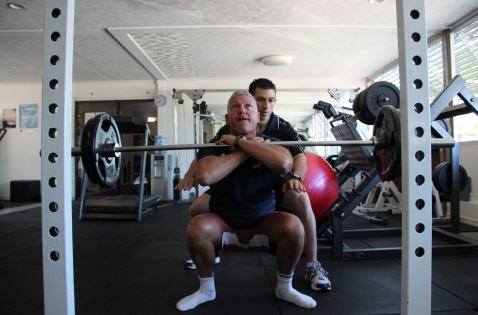
Hire Personal Trainer

First and foremost, understand that your diet is 80-90% of the battle.

Even if you worked with a trainer for 60-90 minutes every day, that still leaves you with 22-23 hours per day to screw things up if you don’t eat properly! Hopefully your trainer will also help you craft a nutritional strategy in addition to helping you build a workout strategy that aligns with your goals.

Start by picking your goals first and determine if a trainer you’re paired up with is the right fit for you. Like dating, you can meet somebody who’s amazing but not right for you. If somebody is a competitive marathon runner, they might not be a great powerlifting coach, and vice versa.

So, start with your goals:

  • Are you trying to lose 300 pounds? 30 pounds? Get to 10% body fat?
  • Are you trying to get stronger or hold your first handstand?
  • Do you want to become a competitive powerlifter?
  • Are you looking to run your first marathon?
  • Do you just want to feel better about yourself and enjoy exercise?

These goals will largely determine the type of trainer you’re looking for.

Make sure your trainer has expertise in the area you want to train in. Expertise in one area does not necessarily make them a good fit in another!

After that, you’ll want to think about what you NEED:

  • Are you just looking for a powerlifting coach to show you the basics (squat, deadlift, etc.) so your form is right? Just a few sessions up front and a few later down the line to confirm you’re on the right path might suffice.
  • Are you new to working out or looking to kick start your first 2 months of training with 2 sessions per week to keep you disciplined?
  • What type of person are you? Do you need more hands-on guidance throughout your workouts, or more space to take ownership and thrive on your own? Do you need somebody who will cheer you on or do you need tough love from somebody to call you on your bullshit?

Once you set proper expectations with what you want and how long you need a trainer for, then you can pick out one that hopefully will work for you.

How to spot a good trainer
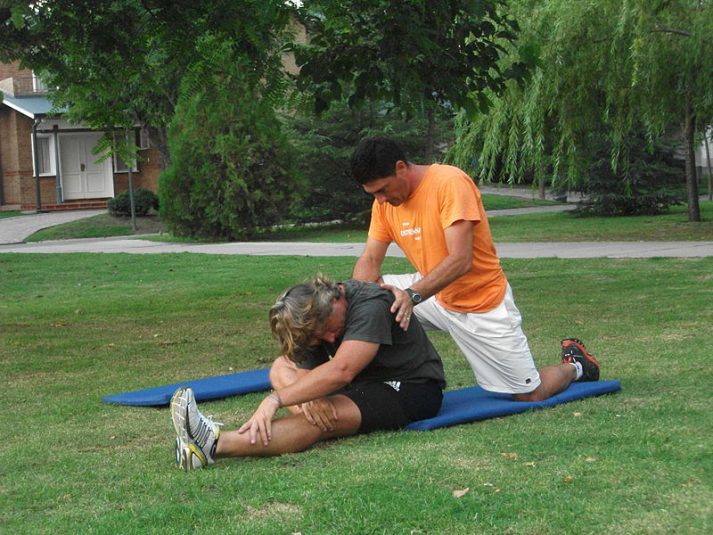
personal trainer stretch

Once you find a trainer you are considering working with, the next steps should always be an in-depth conversation.

Before they do anything else…

They SHOULD be listening to you completely and hearing your story.

They SHOULD ask about any past issues with injuries or experience with exercise. If you’re injured or have any deficiencies, they should know this so they can create a great program for you.

They SHOULD ask you about your nutrition. If they don’t ask about your nutrition, you’re going to be wasting your time.

They SHOULD practice what they preach. They don’t have to be an Olympian, but should have a healthy lifestyle.

They SHOULD tell you about their expertise and how they can help you. They should be able to share past successes of clients with you or point to their credentials and history of success.

They SHOULD set proper expectations. You won’t get ripped in a month, but they can let you know it could take many months to get in shape or build the right kind of habits.

That’s what to look for. Here’s what to watch out for!

Red flags to watch out for

Ahhhhhhh

Beware the “entertainment exercise” trainers with a routine that isn’t catered to your goals.

These are the trainers that just try to confuse you with needlessly complex movements and put all their clients through roughly the same cookie-cutter plan because they know it makes them look knowledgeable without actually knowing anything.

“Now balance on this bosu ball while doing these dumbbell squat lunge curls and standing on one foot with your tongue out! Muscle confusion!”

Tough workouts are great, but remember that while it’s easy to get someone tired, it’s hard to help someone improve over time.

Sure, it might elevate your heart rate and tire you out, but if it’s not building towards your goals in a way that you couldn’t do at home, what are you paying for?

They might also have just obtained a basic certification and stopped their education there, relying on ‘conventional wisdom’ rather than doing the research and building the experience.

If they say any of the following phrases, run for the high hills:

“Yeah you don’t want to squat too low – it’s bad for your knees.”

“Use this machine; it’s safer for you than the free weights.” (unless it’s due to a pre-existing injury you might have)

“Yes, you should be using mostly your back. That’s why it’s called the back squat”

“Now, you’re going to want to cut the fat out of your diet…”

“These (ab) exercise will burn fat from your stomach in no time” (You can’t spot reduce fat.)

I have overheard all of these sound bites from real trainers in real gyms, and it made me weep like the Native American in the 1970s pollution ad:

Your trainer should be results-focused, not focused on scheduling you a new session and keeping you around. I often see clients working with trainers for months and months and that client never looks any different; the trainer is just interested in cashing another check.

Remember, they work for YOU: Don’t let them build a program that doesn’t actually fit your needs. Do you have injuries they’re working around? Do they pick a plan out of a hat and put you through it without focusing on your goals?

Are they actually following along with you? Are they checking your form on movements? Are they encouraging or helping you succeed in the way you want to be encouraged? Or are they scrolling through Instagram models on their phones while you’re doing your sets?

Are they putting in time so they can see you get results? Or are they putting in time so they can check the box and collect your money?

You’re paying money for this person’s expertise and attention – it’s not too much to ask to find somebody who takes those things seriously.

What are good certifications to look for? How much should a trainer cost?

personal trainer night

There are a wide variety of personal trainer certifications and other “credibility indicators.”

The more traditional path – a degree in exercise science or kinesiology may mean the trainer in question is knowledgeable about the human body, but doesn’t speak to any experience they may or may not have coaching in real world circumstances.

Five of the most popular certifications are NSCA, ACSM, NASM, ACE, and Crossfit. T-Nation provides a rundown of the pros and cons from a trainer perspective that we feel is useful insight from a client’s perspective. Be sure to check them out if you want to learn more about what’s behind your trainer’s certification.

CrossFit certifications are completed in a single weekend. While a CrossFit certification does not make a trainer bad (there are plenty of excellent CrossFit coaches out there), it does not guarantee excellence. Here are our thoughts on CrossFit, by the way.

A certification from NPTI – the National Personal Training Institute – is a credential gained from going to a full school on personal training (rather than attending a class or taking a test). While no certification can fully promise excellence, in our experience trainers with NPTI certifications are worth your consideration.

After all that, I’d be remiss if I didn’t mention that I know plenty of trainers who have NO certification that are incredible, and I know other trainers who have the most elite certifications who aren’t that good. A certification can be a starting point, but don’t let it be the determining factor.

In fact, one of the most important things to look for in your trainer isn’t a credential or certification at all, but real experience and an enthusiasm for helping you reach your goals.

Are you looking to powerlift or get into Olympic lifting? Look for someone who has successfully competed in their fields, or someone who actually coaches athletes who do compete! In our view, finding a trainer with proven experience and a track record of performing or coaching (or both) in the area of your goals is the most valuable step you can take to ensure quality. The credential is only a starting point.

Trainers aren’t cheap, but the benefits can be priceless. Remember, you aren’t paying simply for their time with you, but for the years and years they’ve spent learning, training, and coaching. It’s the years behind the certification that makes their time so valuable, so expect the cost of a trainer to be significantly more than the cost of a basic membership at your gym.

In my personal experience, I’ve been working with an online coach since 2014 and it’s the best money I spend every month.

Find the right coach, and it’s worth every. freaking. penny.

SHOULD I HIRE AN ONLINE PERSONAL TRAINER? WHAT ARE THE PROS AND CONS OF AN ONLINE PERSONAL TRAINER?

I’m naturally going to be super biased on this question, because as I’ve mentioned, I’ve been working with an online trainer for the past four years, and it’s what allowed me to prove an internet troll wrong!

Okay, maybe I’m also biased because we offer 1-on-1 online personal training too. However, let’s chat about this honestly because there are some pros and cons to virtual vs. in-person coaching.

Pros to Online Personal Training:

Freedom to fit your schedule. With an online personal coach, you can train when and where you want to fit your schedule – your coach builds the workout program for you ahead of time, so you can fit it in at your convenience. Compare this to a traditional coach, and you’re at the mercy of their busy schedule. If they only have time Friday morning at 8am, and you’re not a morning person, conflict ensues.

Persistent worldwide accountability. I’m borrowing this phrase from a NF Coaching Client, Jeff (his success story is great). No matter where in the globe you are, your online trainer comes with you. Which means the accountability never stops. If you travel for work, your coach can plan for that and build you a special travel routine. Getting relocated for work? No problem – your coach will still be there.

Nutritional guidance. With most traditional personal trainers, you engage with them only during your scheduled visits: they help you work out and that’s about it. With an online personal trainer, you’re connected whenever you have access to the internet. And I would imagine that MOST online coaching programs, work with you on the most important part of the equation: nutrition. AKA everything that happens in the 23 hours outside of the gym.

More cost-effective. Most in person personal trainers are expensive, especially if you work out with them two or three times a week. That’s because if your trainer is working with you, they can’t work with anybody else at the same time. When you work with an online coach, because you aren’t training with them 1-on-1 in the gym, they can provide more cost effective guidance.

When you factor in their availability via chat and their help on habits and your nutrition, you’re looking at a life changing experience if you find a coach that fits your personality.

When comparing online coaches versus regular coaches, I’m going to share the cons as if you have the option between a GREAT online coach and a GREAT in-person coach.

Neither of those are guaranteed.

Here are the cons of an online coach when compared against a real life equivalent:

Your coach can’t do the work for you. There’s nothing stopping you from skipping your workout and lying to your online coach that you did it. Nobody wins in this scenario, but I can totally see it happening.

So yeah, an online coach can’t pick up the weight for you, and they can’t yell at you to put down the donut. You have to do the work!

No real time feedback and instant form check. If you’re learning how to powerlift, or you’re going for a particular heavy lift, having a coach right there is HUGE. They can tell you to move your squat slightly wider. They can guide you through the movement and consistently remind you – even when tired – to keep great form.

Although we do form check videos, where we have coaches and clients send clips back and forth to each other, it’s not the same as having somebody critique you in real time.

If you’re looking to nail a particularly challenging lift, or learn a dangerous gymnastics move, working with a trained professional in person is invaluable.

The value of sunk cost. If you pay for a month of online coaching, there’s nothing inherently motivating you to go to the gym when it’s cold and you’re tired – your coach can’t yell at you, and you’re not letting anybody down in the moment when you don’t make it.

Compare this to working with a real coach in person. You paid $100 for a session, and if you don’t show up, that money is *POOF* gone. So you tell yourself, “I already paid for this, and my coach is gonna be mad, I should probably go.” And then you go. And you’re so glad that you did.

Although your online coach can notice that you haven’t signed in on your app, and they can ask what’s going on, this is after the fact compared to an in-person coach getting stood up.

There’s a lot to consider when debating in-person training vs. an online coach. I wouldn’t say one format is clearly better than or superior to another. It really depends on what you’re after and the circumstances of your situation.

MY PERSONAL EXPERIENCE: I’ve been working with an online trainer for the past 4 years. It’s truly been life changing for me. I had some goals that had evaded me despite a DECADE of effort, and it took a great coach to coax out the right strategy. It’s how I say (jokingly) that I went from Steve Rogers to Captain America.

And it was my coach’s programming that got me a 420 pound deadlift at a bodyweight of 172 pounds:

I’m not gonna set any powerlifting records, but I’m healthier, more antifragile, and stronger each and every month, and I’m damn proud of that.  For somebody that can’t afford a top-of-the-line professional coach for each session, having an online coach to build your programming and guide your food choices is a verrrrry close second.

Next steps
Dave During Workout

Here’s my advice: give a trainer 5-10 sessions before making a decision that things aren’t working out (sessions are often sold at a discount in a package).

The first session is often exploratory, explanatory, and introductory, and the trainer needs to test your limits and movements to build upon that. This isn’t a “get fit quick” strategy, but rather one that could take months and months for you to find the right person to aid you on your journey. Don’t expect miracles in a day!

A few words of warning:

DO NOT USE YOUR TRAINER AS AN EXCUSE: Too many people will hire up a trainer and give no effort in the gym or the kitchen. Then, when they fail to see results they can turn to their friends and say “man, my trainer is terrible, THAT’S why I’m not losing weight/getting stronger/etc.” This happens so much more often than you’d think. A trainer is a guide, like Morpheus. You have to take the pill and walk through the door yourself.

MAKE CRITICISM CONSTRUCTIVE CRITICISM! Often when the trainer asks them to do something (walk every day, throw away junk food, eat a vegetable), the client/trainee comes back with 1,001 reasons they can’t do that. No compromise, no discussion of possible solutions. Instead of saying “no,” offer an alternative solution and negotiate a plan: “I don’t really like broccoli, do you have a good recipe?”

IF YOU ENJOY WORKING WITH YOUR TRAINER: Let them know and continue working with them. The more information you can give them on your progress, the easier it will be for them to alter your program as you go on.

IF YOU DON’T ENJOY WORKING WITH YOUR TRAINER: That’s okay too. Not all relationships end in marriages. Some first dates suck, and some trainers aren’t what you need. I think you can be honest with them and let them know that it’s not a good fit and you will not be continuing to work with them. Good trainers at this point will ask what they could have done better. Trainers who are simply after your money may guilt trip you or beg you to stick around. Try somebody new and keep the search going.

Remember: this is a lifelong quest, and you’re on the hunt for a great guide to help you on your journey. They won’t do the work for you, and they can’t work miracles. Have proper expectations, do what you’re told, and this could be the best investment you’ll make in your entire life!

Trainers in the Rebellion, what did I miss?

Those who have had experience working with Trainers, any wisdom to share from your experience?

One final note: Going to a gym is intimidating, especially if you’re starting out. And not knowing the difference between a bad trainer (who is all talk) and a good trainer (who will prioritize your needs and get you results) can result in months of lost effort (not to mention lots of lost money too!)

It’s why we created our own experience for our community.

If you are in a location where there aren’t any great trainers, you don’t have access to a gym, or you’re just not ready to work with somebody in person, consider checking out uber popular 1-on-1 Online Coaching Program!

We build a workout program specific to YOUR goals, we help you make better food choices (which is 90% of the battle), and we help keep you accountable.

No guesswork. No confusion about what to do next. Just a coach you can text with questions, that builds a program for you, and can even check your form via video!

Schedule a free call to learn more by clicking on the image below:

If you have questions about what you need to look for when it comes to training with a coach in person, or even questions about working with an online trainer, leave them in the comments below so I can chime in!

-Steve

###

photo: wikimedia: high five, Gregg Wass: Trainer, Wikimedia: Spot, BicycleWikimedia: stretchins


source https://www.nerdfitness.com/blog/how-to-hire-a-good-personal-trainer/

Should You Try The Carnivore Diet? 5 Questions Addressed

If you want to get some concerned looks from your friends and family, tell them you are following an all meat or Carnivore Diet.

It seems to fly in the face of common sense to eat meat, more meat, and nothing but meat.

Yet I see a growing trend of eating a carnivore or “zero-carb” diet. To eat meat, and solely meat, in the name of health.

The popularity of eating only meat made me curious enough to explore the topic. It might be completely and totally insane, but if there are health benefits to eating steak all day, I vow to get to the bottom of it.

So today, Nerd Fitness looks at:

  • What is the Carnivore Diet?
  • What are the claimed benefits of an all meat diet?
  • What do you actually eat on a Zero Carb Diet plan?
  • Is the Carnivore Diet safe?
  • Would I recommend anyone actually try this?

Alright, fire up the grill. Let’s talk meat.

What Is The Carnivore Diet?

In simple terms, the Carnivore Diet is the following: Eat meat. Drink water. Consume nothing else.

If you like steak, and not much more, this could be the diet for you.

The carnivore diet—as the name implies—is eating only animals products. Meat, more meat, topped with meat. No vegetables, fruits, grains, legumes, nuts or seeds. Just meat. Dairy MIGHT be included, depending on your interpretation of the diet. Yes, it’s from an animal. However, lactose is a sugar (carb), which might be frowned upon. It depends on who you talk to. We’ll touch on different versions of meat-eating later.

The big point of the Carnivore Diet is to eat no plant products.

The literal opposite of a vegan diet.

If you thought the Paleo or Keto Diet were restrictive with regards to carbs, welcome to the next level. Eating only one food group, meat, is about as restrictive as you can get. Right up there with the Potato Diet or the “30 Bananas a Day” Diet, which are both real things, but for another day.

You might have also heard of the Carnivore Diet as the “Zero Carb Diet.” However, this is a little bit of a misnomer, because there are actually some carbs in meat. They come in the form of glycogen. Although this could be nitpicking because the total carb content is minimal, but it’s worth noting.

No matter what you call it, this diet of only animal products has grown in popularity in the recent past.

But its history actually goes even farther back…

THE HISTORY OF THE CARNIVORE DIET: A WHALE OF A TALE

If you’re going to have a debate on the merits of eating only meat, we should probably have a discussion about the Inuit.

The Inuit are an indigenous tribe inhabiting the Arctic. What’s important about the Inuit, for this article, is they have traditionally eaten a diet high in meat.

There’s not a whole lot of fresh plants in the icy Arctic. Especially in the winter months, when sunlight becomes scarce. So in order to survive, the Inuit traditionally had to subsist on a diet of seal, walrus, fish, and other animals products.

There just wasn’t much to eat outside of what you could hunt.

The interesting thing: the Inuit have traditionally held low rates of heart disease coupled with no nutritional deficiencies.[1] That is until, sadly, they were introduced to a more Western diet: including pizza, chips, and soda. Then as you would predict, diabetes and obesity rates rise.

The health of the Inuit, despite their restricted nutritional choices, is often referred to as the “Inuit Paradox” of a high meat, high fat diet.

So let’s bring things into a more modern era and chat about Vilhjalmur Stefansson.

Stefansson was a Harvard-educated Arctic explorer born in 1879. If you’re imagining some type of wiley-Indiana-Jones-like character, you wouldn’t be wrong.

When exploring the Arctic, Stefansson lived off the land, by adopting the Inuit way of eating mostly meat. At first, Stefansson did it out of necessity. But then a Carnivore Diet became his preference. When he returned to his home, Stefansson commented on how an all meat diet made him feel the leanest and healthiest.

Stefansson may be one of the first proponents of a “no carb diet,” as he gave many interviews and reports on his experiences eating like a carnivore. He even wrote an article where he discussed his adventures in the Arctic, including why he adopted an all meat diet.[2]

An important point on Stefansson: he prized the fattiest cuts of meat he could find, and ate unconventional parts of an animal, just like the Inuit. Stefansson explained that he varied between, “steaks, chops, brains fried in bacon fat, boiled short-ribs, chicken, fish, liver, and bacon.” So yeah, not just ribeyes…

So why is the Carnivore Diet becoming popular now?

Simply put, a man named Shawn Baker.

Baker literally wrote the book The Carnivore Diet.

Now, before you send me an email explaining that Baker’s license to practice medicine in New Mexico has been revoked, let me say that I’m aware. And it is noteworthy. However, I don’t want this fact to prevent us from looking at the ideas and evidence of an all meat diet, especially considering the fact that you’re reading this to get the real story!

Despite the controversy surrounding Baker, there does seem to be anecdotal evidence on the benefits of eating only meat. There’s an entire subreddit of people consuming only animal products, claiming it’s helped them in all sorts of ways.[3]

Folks report losing weight, curing autoimmune diseases, and raising testosterone. All by forgoing any kind of plant product.

Which is a good segway into our next section…

What Are The Benefits Of The Carnivore Diet?

The benefits of the Carnivore Diet rests on two points:

  1.  To lose weight.
  2. To fix or identify food intolerances or allergies.

Both of these points actually make sense to me.

To lose weight, you need to expend more calories than you consume. And if all you are consuming is meat, you’re cutting out most major food groups.

Like, all of them, except one.

And meat can be very satiating, meaning it’ll keep you full. So I imagine a lot of folks following the Carnivore Diet are just subconsciously eating fewer calories than they were in the past.

That’s why I believe a lot of the anecdotal evidence of people achieving weight loss success with this diet.

However, as I point out in the “Perfect Diet” article, any diet that results in calorie restriction will likely work when it comes to weight loss – at least in the short term. You can lose weight on the Twinkie Diet, but that doesn’t necessarily make it sustainable or healthy!

So, whether it’s the Carnivore Diet or Intermittent Fasting or Paleo, if you have a plan and can sustain it, results will probably follow. We’ll touch on this again later.

Onto point 2: How about eating only meat to fix food allergies or intolerances?

If you have a food intolerance, it means you have some sort of negative reaction to a specific type of food. Gluten or dairy or nightshades, for example. Eliminating these potential causes for illness or discomfort in an attempt to see how your body responds makes logical sense.

And in fact, many scientific studies rely on some sort of elimination or oligoantigenic diet (another term for an elimination diet), to identify potential allergy issues in patients.[4]

The big difference is, a lot of these elimination diets are designed to be temporary, with the goal being to reintroduce many safe food groups over time. Conversely, the Carnivore Diet aims to eliminate these permanently. In other words, there is no reintroduction stage. You just keep eating meat.

What’s so special about meat, and why eat only animals? The argument goes something like this:

#1) Meat protein is highly bioavailable. Animal protein has all the amino acids you need to live. And since you yourself are animal meat (weird to think about), the thought is your body doesn’t have to do much conversion for utilization.

Also, some nutrients like creatine, carnosine, and vitamin B12 are only found in meat. The argument goes, eating meat is the easiest thing to support your own meaty body.

#2) Meat is a low allergen threat. With the exception of some seafood and shellfish, most people are not allergic to meat. Especially red meat.[5] That’s often why elimination diets okay red meat, as long as it hasn’t been processed and pumped full of additives (potential allergens).

However, it is worth noting there is a tick whose bite has been linked to creating an allergic reaction to red meat specifically.[6] Nature can be cruel. However, for the most part, people are not very allergic to meat.

#3) Phytonutrients in plants can be pesticides. Since plants don’t have legs to run away from a hungry critter, they have to rely on other means to escape being eaten. Sometimes, it’s an outer barrier, like bark. However, it can also be chemical warfare, with plants producing toxins to poison, kill, or just bother whatever animal is eating them.[7]

The theory goes that people can be allergic to these chemicals. Now, we’ve evolved to handle these phytonutrients, and they actually provide health benefits for most.[8]

That’s why many health professionals encourage the consumption of vegetables, fruit, and grain. However, people can indeed be allergic to certain phytonutrients, so the argument from the pro-all-meat camp states to avoid them completely.

There’s a counterargument for each point above, which we will get to. However, the carnivore community does have some interesting objections to eating plants.

Okay, so we’ve discussed why people would eat only meat.

What’s this Carnivore Diet actually look like?

Is it as simple as it sounds?

WHAT DO YOU EAT ON A CARNIVORE DIET? WHAT’S ALLOWED ON A ZERO CARB DIET PLAN?

I thought about answering this section’s question with one word, “meat,” and moving on. However, there are some specifics and alternatives worth discussing for the Carnivore Diet meal plan.

First, if it’s an animal, it’s allowed on the Carnivore Diet:

  • Beef. The primary meat of choice for those on the Carnivore Diet seems to be beef. Shawn Baker practically lives on ribeye steaks at home and ground beef patties when he’s out and about.
  • Lamb. Another red meat often consumed on an all meat diet.
  • Pork. You have permission to eat bacon on the Carnivore Diet, or other pork products.
  • Fowl. Our feathered friends are acceptable on an all meat diet. Chicken, turkey, duck, etc.
  • Fish. If it swam, go for it. Even if it didn’t (muscles, oysters), if it’s an animal from the sea it’s fair game.

A good rule of thumb: if a Tyrannosaurus rex that’s escaped from its pen would eat it, you can eat it too.

Just a little dino humor here. Though Triceratop Tri-Tip would also fit the menu.

I know your next question: “Steve, how about dairy? It’s an animal product. Yay or nay?

Technically, dairy can be allowed, as it’s from a cow. However, some advocates of the Carnivore Diet say skip it altogether, because of the possible concern of lactose intolerance.

It’s not the only gray area on an all meat diet.

How about coffee or tea? Well, they aren’t from an animal, that’s for sure. But the calories they contain are practically zero.

Allowed? Eh, I’d say it depends on your goal.

If you’re experimenting with a Carnivore Diet for weight loss, yeah, why not? Because again, there are almost no calories there. If you’re doing an all meat diet to determine possible food intolerances, it should be noted that people can be allergic to coffee or tea. That’s why many elimination diets advise against them for a period of time.

The same argument could be made for spices or herbs to season your meat. No calories, but again, potential allergens. Outside of salt, any kind of seasoning allowance will depend on who’s advising you on the Carnivore Diet and why you’re doing it.  

And you might want to think about proper advice when following an all meat diet.

IS THE CARNIVORE DIET SAFE?

Most dietitians would advise against eating a Carnivore Diet. Because, you know, the whole no fruits or veggies thing. And while here at Nerd Fitness, we believe in questioning everything (Rule # 8), the medical community might have a point on this one.

Now, I’m on the record for saying I don’t buy the studies on red meat being the most dangerous thing you can eat.[9] However, I don’t think this provides a giant green light to live on nothing but red meat either.

There are some things you really need plants and vegetables for. Some examples:

  • Betaine is a vital nutrient needed for liver function. The best source? Spinach.
  • Potassium is an electrolyte needed to help regulate blood pressure. Bananas, avocados, and leafy greens are great sources for potassium. While there is some potassium in meat, it’s debatable if it’s enough.
  • Magnesium is a mineral which your body requires for literally hundreds of bodily functions. The best source? Greens, like spinach.
  • Fermentable fiber is critical for our stomach’s microbiome. And in recent years, our knowledge of how import gut health is for overall wellbeing has grown.[10] Eating an all meat diet could have a big impact on gut health, because of the complete lack of fiber found in animal flesh.

And let’s circle back to both the Inuit and Harvard explorer examples from above. There are two things they did that most modern Carnivores probably aren’t doing:

  • They ate all sorts of different cuts and pieces of meat. The Inuit and Stefansson did not just eat lean pieces of caribou. They’d eat eyeballs, brains, and other organ meat, where a lot of extra nutrients can be hidden. They would also eat whale skin, which contains vitamin C.[11] These “unconventional” cuts of meat hide a lot of extra nutrients the Inuit needed to thrive.
  • The Inuit traditionally did eat some plants. While granted, there’s not a lot of fresh greens up in the Arctic. There are some, which the Inuit would eat when available.[12] The Inuit would dine on berries, sea vegetables, and certain mosses when in season. While these plant products made up a small portion of their overall diet, it still provided them with additional vitamins and nutrients to complement their carnivore leaning ways. So it would be inaccurate to say they ate only meat.

So they’re not just eating lean chicken breast and grass-fed fillets. They’re eating the organs and other portions of animals that are LOADED with nutrients.

But let’s get back to the challenge at hand.

Who knows what a diet devoid of vegetables can do to the body? The scary thing about that question is the answer: no one knows. That’s because there are no clinical trials done on a long-term Carnivore Diet.

Some in the pro-all-meat camp will cite this a defense. No one has studied eating only meat. Perhaps their potassium requirements are different?

While an interesting counterargument, I veer away from the extremes when it comes to diet, especially if you don’t plan on making the changes permanent. Double especially with diets as extreme as a Zero Carb Diet.

I try to keep things simple, and not vilify or deify certain foods.

Carbs are not inherently evil. Fat is not a health food. Protein is just one piece of the equation.

Our stance: I would advise against the Carnivore Diet, especially in the long term. And no diet should be started if it’s only going to be done temporarily. This creates temporary results. And the idea of only eating meat seems incongruent with a healthy, long lifestyle.

Maybe one day, the anecdotal claims of the benefits of an all meat diet will be verified. For now, I don’t think there’s enough evidence in support, but enough to be concerned about pinning one’s health future on it

You do you, but be careful.

Sigh, you’re gonna try it, aren’t you?

Welp, I’ll get to my advice in a moment.

But there’s no way we can’t walk about…

BOWEL MOVEMENTS ON AN ALL MEAT DIET

Eating only meat is going to impact how and when you go to the bathroom. There’s no way out of it. Every person who writes about their experiences on a Carnivore Diet addresses it.

For one, the lack of fiber means you are going to poop less frequently.

Poop is made out of mostly water (75%), but it’s also composed of bacteria, protein, and fiber.

If you eat no plants, you aren’t getting fiber, which means less poop.

Also, when you go #2, it will likely be mushier (gross). Again, the no fiber thing.

It should be noted, however, that followers of an all meat diet claim that while they don’t go to the restroom as frequently, they do not feel constipated. They simply don’t have to go.

So, ah, yay, less bathroom time?

I’ll also add some confusion to this section, by addressing a study that demonstrated people actually eased constipation by reducing or eliminating dietary fiber.[13]

My thoughts on this study come back to balances and extremes. You need some fiber, but with anything, you can have too much as well.

Okay, I think we talked about poop enough today. We had to do it though. You know in your heart this is true.

IF YOU TRY THE CARNIVORE DIET, DO THIS

If you don’t heed my warning and decide to try the Carnivore Diet anyway, there are some things to consider.

Mark Sisson from Mark’s Daily Apple[14] has some great suggestions on ways to potentially make a Carnivore Diet more sustainable:

  • Take magnesium. As I said a little bit ago, it wouldn’t be a joke to say your body runs on magnesium. I would hedge my bets and take a supplement.
  • Eat eggs. It’s an animal product. Plus, it’s got all the ingredients (and nutrients) to make a bird. This could help with some of your potential nutritional deficiencies.
  • Eat liver. The liver is one of the most nutrient dense organs found in the body. Mark Sisson calls it “nature’s most bioavailable multivitamin.”

So think about a supplement or two and don’t just live off ground beef. Animal organs are very nutritious. And maybe sneak in some occasional greens as the Inuit did.

Lost?

Are you even more confused than when you started this article? I hear ya. Hopefully, I’ve dissuaded you from trying this diet out, but you’re an adult and you can make your own decision.

I understand that nutrition advice can be confusing and often contradictory. One day saturated fat is bad, the other it’s all people are eating.

That’s why we’re here to help!

If you’re looking for comprehensive nutritional guidance that fits your lifestyle we got you!

Nerd Fitness offers a 1-on-1 Online Coaching Program. We work with busy people just like you to create and achieve their health goals. And we don’t depend on insanely restrictive diets like eating only steaks or subsisting on just potatoes (again, an actual diet strategy).

We’ll get to know you and offer tailored advice so you can get stronger or you can begin your weight loss journey. If you want guidance from a trained professional, schedule a call by clicking on the image below and see if we’re a good fit for each other!

EATING A HEALTHY DIET PERMANENTLY

I don’t advocate diets that are designed to be unsustainable or short term.

And don’t even get me started on cleanses.

In the fitness world, we call them “crash diets.” While they may indeed help followers lose weight, they are not designed for the long term. If you go back to your normal way of eating after your temporary change in diet, you’ll likely regain all the weight you lost. This can prove to be a frustrating step in the fitness journey.

That would be one of my main concerns on the Carnivore Diet. It just doesn’t seem sustainable to me, which means any benefits you derive from it would disappear as soon as you go back to how you formerly ate.

The other concern would be not eating vegetables.

Now, if you are trying the diet to identify food intolerances or allergies, that’s one thing. However, if you’re after weight loss, I would STRONGLY advise a different path.

Try one small incremental change. Something you can stick with. Not eliminating most food groups.

Perhaps it’s one less soda a day. Or a side salad instead of french fries. Or maybe it’s exercise-related and begins with just taking a five-minute walk at first. If it’s something you can imagine doing the rest of your life, it’s a great start. We can then work on building you a second healthy habit.

If your change seems like an impossible lifestyle for years and years, likely to be abandoned, maybe try something else.

If you are experimenting with the Carnivore Diet as a potential temporary elimination diet: track everything! Track what you ate and how you felt each day. Even note bathroom behavior. Track it all. Then, once you have some data, you can start to reintroduce foods to see if they create an impact.

That about does it for my thoughts on the Carnivore Diet.

Now, your turn:

  • Am I way off on this one? Should we all be eating steak for every meal?
  • Is this diet even crazier than I am alluding to?
  • Have you tried it? Know someone who has?

Let me know in the comments!

-Steve

PS: To even this out, we’ll be publishing an article on veganism/vegetarianism soon!

PPS: If you want help making one small incremental change you can sustain for the rest of your life, I’ll again remind you of our 1-on-1 Coaching Program. We help hundreds of nerds just like you create healthy habits (that stick) to level up their lives. If you’re interested, click here to learn more. We’ve love to talk to you, no matter what you decide.

###

All photo citations can be found in this footnote.[14]


source https://www.nerdfitness.com/blog/should-you-try-the-carnivore-diet-5-questions-addressed/

Thursday, 10 January 2019

Pull-Up (Master Resource)

Pull-ups are my favorite exercise of all time.

They work all of the “pull” muscles in your body – your back, biceps, forearms.

They are indicative of your level of fitness – anybody that can do a pull-up is in pretty good shape.

And anybody that can do 10 or more is clearly in great shape.

Lastly, pull-ups make you feel like a badass after doing them.

However, pull-ups are also hard as hell, especially if you’re just getting started. Unlike other exercises that can be completed with just your body weight (like squats, lunges, and push ups), pull-ups and other exercises that strengthen your pull muscles require at least one piece of equipment or something to hang from!

On top of all of that, if you can’t do one yet, how the heck are you supposed to work on them to get better?

I’ve recently received thousands of emails from fellow rebels who are working towards their first pull-up but aren’t there quite yet.

Whether you’re 300 pounds overweight and can’t even look at a pull-up bar without freaking out, or you’re half an inch away from finally being able to do your first pull-up, this article is for you – sorry it took so long for me to write!

Pull-ups are quite the intimidating exercise, but as Optimus Prime has taught us, we can make small changes and improvements over time that will result in the ultimate goal:

One. Freaking. Pull-up. 

It will take a combination of two things to get your chin up over that bar:

  • Decreasing body fat so you have less weight to pick up!
  • Increasing strength to pick up your bodyweight and move above the bar!

I realize doing those two things is much easier said than done.

What most people don’t realize is that they spend too much time on the strength part, not realizing that decreasing their body weight is as important and impactful (if not more so!).

Which is why most people never get to do a pull-up!

After all, there’s nothing more frustrating than putting in effort for months (or years) and not seeing results and getting demoralized. And unfortunately, this is what I see from most people: Lots of well-intentioned but misguided effort in the gym and no changes.

You probably don’t have years to make the mistakes that I did and want to skip this problem, and you just want to start getting results today.

In addition to the free resources below, we also offer 1-on-1 Online Coaching, where you’ll get personalized instruction for your body type and goals, and professional accountability from a Coach on Team Nerd Fitness!

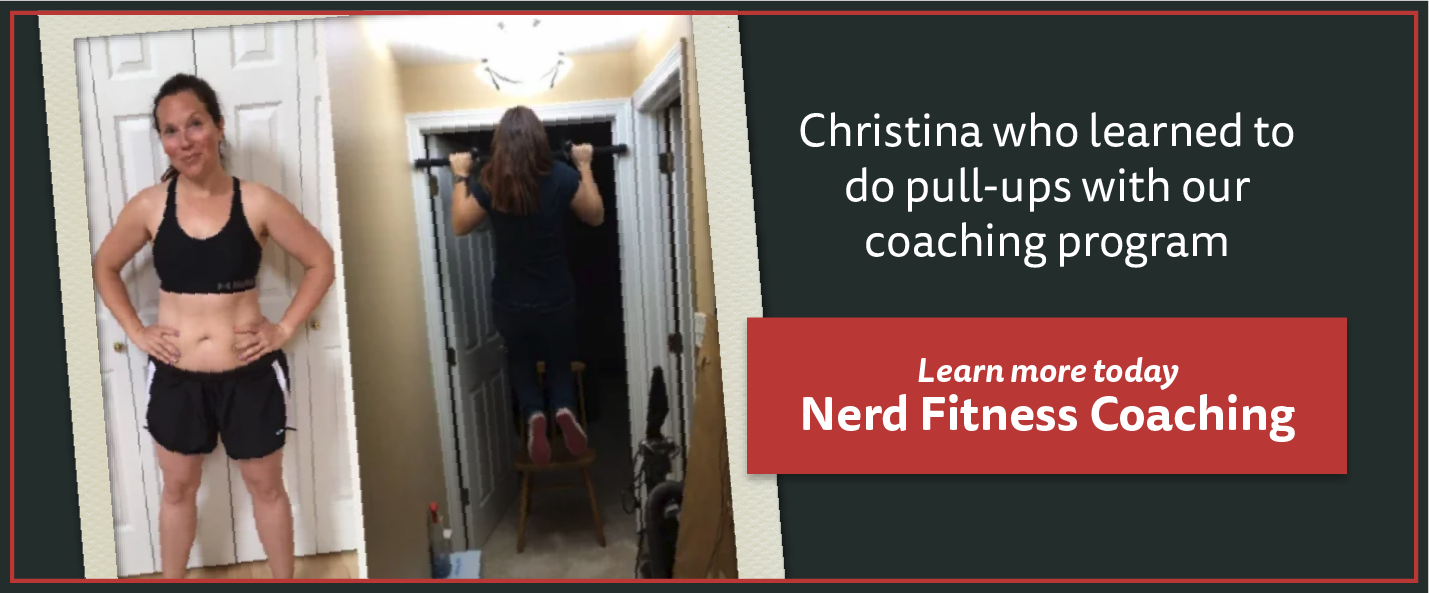
You can schedule a free call with our team to learn more about coaching by clicking on the image below of Christina! She’s one of our coaching clients who went from 0 pull-ups to now doing sets of 10!

But enough of that, let’s get into the nitty-gritty of how to get your first pull-up!

A few tips to get started

This should hopefully be obvious, but the more you weigh, the more you have to lift in order to complete a pull-up. If you’re truly serious about completing a pull-up, start by getting your diet under control.  I’m a HUGE fan of the Paleo Diet, because I know it works. A few folks have already lost 10+ pounds in just over a week following the Paleo Diet in the Nerd Fitness Academy. As you start to weigh less, you’ll have less weight to pick up and move up over that bar!  Got it? good.

MAKE YOUR BACK EXERCISES A PRIORITY. A lot of people do every other exercise before doing any back-related exercises, if they do any at all.  After warming up properly, your first exercise should always be the stuff that you want to work on the most – in this case it’ll be your back.

The progression below is just a path that I’ve created, but does NOT need to be followed to a T. I give sample sets and reps and when to move up, but if you feel like you can progress sooner or want to try doing full pull-ups sooner than I recommend, that’s OKAY.  This is the slower progression method, where some people will want to do fewer reps and progress to the next levels sooner – that’s okay.

I recommend moving up to the next level when you can do 3 sets of 8 reps of a particular exercise. If you want the accelerated path, move on up as soon as you can do 3 sets of 5 reps.

Almost every exercise below has a video to show you how to do it. Click on the picture or the video below it.

If you want to know how to incorporate the progressions below into a regular training routine, you can put your email address below to download our beginner bodyweight workout! It’s a great way to get strong as you also get better at your pull-ups!

Level 1: Bent Over Dumbbell Rows


Bent Over Dumbbell Row Video

We’re going to start with these, the most basic of back exercises, in case you’re starting from ABSOLUTELY square one. For these exercises, focus on lifting more and more as you get stronger.  Every OTHER day, pick up a dumbbell that you can lift for three sets of 8 repetitions with a 2 minute break between sets.  As soon as you can do 3 sets of 8 reps, it’s time to move up to a heavier dumbbell.

  • As soon as you can do dumbbell rows with at least a 25-pound (10kg) dumbbell or heavier, consider moving up to the next level.
  • If you are a little bit bigger than the average bear, you might want to stick with this step until you lose a little bit more weight and get stronger – maybe go to 35 or 40-pound (18kg) dumbbells.

Level 2: Body Weight Rows


Body Weight Rows Video

Body weight rows are the PERFECT precursor to pull-ups – they work the same muscles, just at a different angle.  You can also make adjustments.  You know how I HATE HATE HATE exercise machines? Here, I wholeheartedly recommend the use of a smith machine…but ONLY for rows!  Because you can adjust the height of the bar, you can adjust how difficult the exercise is.  If you’re just getting started, put the bar very high, so you only have to lean back slightly.  If you’re stronger, you can start with a lower bar.

Here’s a whole post I did on body weight rows (also called inverted rows).

My advice:

  • Clench your butt and keep your abs tight and body straight throughout the exercise.  Focus your mind on PULLING with your arms.
  • Set the bar at a height where it’s challenging for you to complete 3 sets of 8 reps with two minutes of rest between sets.
  • As soon as you can complete all 3 sets of 8 reps, lower the bar!
  • If you need to make the exercise easier, bend your knees and put your feet flat on the ground.  You can drop your hips too to make things easier.

A sample routine that starts with your back exercises

  • Monday – 3 sets of 8 reps of overhand bodyweight rows
  • Wednesday – 3 sets of 8 reps of underhand bodyweight rows (hands reversed)
  • Friday – 3 sets of 8 reps of overhand bodyweight rows
  • (And then go underhand, overhand, underhand the following week)

As soon as you’re doing bodyweight rows where your body is at a 45 degree angle or lower, you can progress to level 3.

IF YOU DON’T HAVE ACCESS TO A BAR FOR INVERTED ROWS: Try using your kitchen table, or move up to Level 3 and progress with caution there.

IF YOU HAVE ACCESS TO A GYM OR WANT TO JOIN A GYM, I know they can be intimidating! We have multiple chapters on how to find a gym and get started using the equipment, in our free guide Strength Training 101: Everything You Need to Know. Grab our nerdy guide when you join the Nerd Fitness Rebellion with your email in the box below:

Level 3A: Assisted Pull-Ups


Assisted Pull-ups Video

At this point, you’re gonna need to find a bar. Find one that will support your weight, anywhere. I don’t care. Just find one.

If you have a gym membership there will be pull up bars all over the place.  At your house you might have “the perfect pull up” in your door way.  If you have neither of these things, find a local playground and use their monkey bars.  This is one piece of equipment that NEEDS to be in your arsenal, so find a way to get one.  No excuses, play like a champion.

Let’s chat about how to do an assisted pull-up.

Personally, I don’t like using the assisted pull-up machine in a gym as it doesn’t give you the full feeling of a pull-up, but it’s certainly better than nothing.

Instead, I recommend doing one of these alternatives:

  • Assisted Pull-ups with chair – (either one foot or two depending on your needs) – your feet are ONLY there for support, use your upper body as much as possible.
  • Assisted Pull-ups with exercise band (you can get different types of exercise bands with different levels of strength).  Put your foot in the exercise band and pull yourself up.
  • Assisted pull-ups with a partner – (have a friend hold your feet behind you and help you complete each rep).  Have your friend use the least amount of help possible to get you through your workouts.

My advice:

  • Clench your butt and keep your abs tight throughout the exercise – try not to swing like crazy.
  • Keep your shoulder blades pinched behind you throughout the movement and focus on PULLING the bar down with your arms.
  • Use the least amount of assistance that you can handle – as soon as you can do multiple pull-ups with both feet on the chair, switch to just one foot.
  • If you’re using an exercise band, try to get a few bands of varying tension so you can decrease the resistance as you get stronger.
  • As soon as you can do 3 sets of 8 with assistance, it’s time to move on up.

A sample level 3 routine:

  • Monday – Assisted Pull-ups – 3 sets of 8 reps
  • Wednesday – Body weight rows – 3 sets of 8 reps
  • Friday – Assisted Chin Ups – 3 sets of 8 reps

Level 3B: Negative Pull-Ups

Now, let’s say you don’t have a rubber band, you don’t have somebody to hold your feet, and you don’t have a chair – you ONLY have a pull-up bar. That’s okay – you can do what we call negatives.  When doing a negative, you jump above the bar and try to lower yourself slowly and in control until you’re at the bottom of the movement.   This can be very dangerous if you’re very overweight, which is why I’d recommend moving slowly through steps 1-3A first.

However, once you have a decent amount of back strength, doing negatives is a great way to build arm and back strength.

You can either jump above the pull-up bar, and then begin to lower yourself back down IN CONTROL, or you can hop up on a chair to get above the bar and then lower yourself back down.  Again, the name of the game is “in control.”

You don’t need to lower yourself so slowly that one repetition destroys you…lower yourself in a controlled speed – Counting to three during the movement is a good tempo.

Here’s a sample workout using everything up to this point:

  • Monday – Assisted Chin Ups – 3 sets of 8 repetitions
  • Wednesday – Body Weight Rows – 3 sets of 8 repetitions
  • Friday – Negative Pull-ups – 3 sets to failure – capped at 5 repetitions for each set.

For your negative pull-ups, do as many as you can (up to 5 reps) per set – jump and lower yourself in control, then jump right back up and lower yourself.  If you can do 5, wait 2 minutes and then start again.  If you can’t do 5, do as many as you can in control, wait 2 minutes and then start again.

Once you’re doing 3 sets of 5 repetitions on your negative pull-ups, along with your assisted chin-ups and body weight rows…you’re ready.

Level 4 – Chin Ups and Pull-Ups


Pull-up Video

My dear rebel, it’s time.

Depending on your weight, your level of fitness and strength, and how far along you are in these progressions, you might be able to start with more than one pull-up.

For MANY people, especially if you have spent time in the gym in the past working on your biceps (like most guys do), you might find it easier to start with chin ups (with your palms facing toward you) for your first exercise before trying pull-ups (with your palms facing away from you).

  • A PULL UP is when your hands are facing away from you.  This will work your back and biceps.
  • A CHIN UP is when your hands are facing towards you.  Although this also works your back, it has more emphasis on your biceps.

Grab your chosen bar with a grip slightly wider than shoulder width, with your hands facing away from you. Hang all the way down.  Pull yourself up until your chin is above the bar. Slight pause  Lower yourself all the way back down. Go up, and really concentrate on isolating your back and biceps. Don’t swing!

  • Pull your shoulder blades back as you’re going through the movement, and focus on pulling the bar down.
  • Again, keep your butt clenched and your abs tight throughout the movement.
  • Get your chin above the bar, or it doesn’t count as a full rep.
  • Do whatever you need to get through the full rep.
  • If you can only do one rep, try to do at least 3 sets of one rep…after your three sets, add in some negatives to exhaust the muscle.

Want a video walking you through it? You got it:

Once you can do a single pull up, work on doing them in sets.

  • Do one pull up, then wait a minute or two and do another one.
  • Then wait a few more minutes and do another one.

A few days later, try to do two in a row, and do a few sets of two.

Once you’re comfortable, here’s a Level 4 routine set up for a week:

  • Monday – Chin ups – 3 sets for maximums repetitions
  • Wednesday – Inverted Rows – 3 sets for max repetitions
  • Friday – Pull-ups – 3 sets for maximum repetitions

Level 5 – Next steps

Once you’re able to do 3 sets of 10 pull-ups or chin ups, you have a few options:

Personally, my favorite thing to do in a gym is weighted pull-ups; if you’re at this level and interested in doing so, here’s what you need to do:

  • Get a weight belt. I bought this one (affiliate link) on Amazon and it’s worked out incredibly well for me.  I’ve tried doing the whole “put weights in a backpack” and it certainly works, but the angle of the weights hanging off your back is weird.  With a weight belt, the weight hangs down between your legs (not a euphemism) so it feels more natural.
  • Add small amounts at a time. Most gyms will have 2.5 lb (roughly 1kg) weights; you might feel stupid putting on a big weight belt and only hanging a tiny weight off it, but you need to start somewhere.
  • Consistently add more weight. I’ll warm up with two sets of 5 pull-ups with no extra weight, and then do 3 sets of 5 weighted pull-ups.  If I can complete all 3 sets of 5 reps (with my chin over the bar for every rep), I’ll make a note to add 2.5 or 5lbs (1 or 2kg) to my weight belt for the next time.

So, here’s an advanced sample routine for back exercises:

  • MondayWeighted Chin Ups – 3 sets of 5 reps
  • WednesdayElevated Feet Body Weight Rows – 3 sets of max repetitions
  • Friday – Wide Grip Pull-ups – 3 sets of maximum repetition
  • (The following week, I’d alternate by doing the chin ups without weight, and then doing weighted pull-ups

Don’t Make These Pull-up Mistakes!

My work here is just about done – it’s now up to you to take care of business.

As you start to get stronger with your pull-ups, it’s important to check in and make sure you’re doing them correctly. 90% of people I see doing pull-ups in a gym are doing them incorrectly!

Before I let you go, here are the 5 big mistakes people make when doing a pull-up:

Mistake #1: You don’t extend low enough or pull high enough. Full extensiooooooon and full range of motion are major problems for many people training pull-ups and chin-ups. Most people I see in a gym are doing half pull-ups. Either not pulling high enough, not dropping low enough, or both! It’s not a full rep, and it’s robbing your body of effective work.

Solution: Leave your ego at the door! Yes, pull-ups are tough, but half effort gives you half results. With each repetition you want your body to be in a straight line at the bottom – keep your elbows extended and your shoulder relaxed slightly up to your ears. Full range of motion for the win! Better to do a few proper pull-ups than more half-rep ones.

Mistake #2: You don’t engage your shoulders at the start. Another problem I see with people is not setting their shoulders properly when they start their pull-ups, which can put unnecessary strain on your joints/tendons/muscles. It can also be the difference between being able to get your first pull-up or chin-up and flailing around on the bar!

Solution: Imagine pinching a pen in between your shoulder blades, then do the pull-up. In other words, pull your shoulders down and back before you bend your elbows to pull-up. This puts us in a far more efficient position. By not using our back and shoulder muscles fully, over the long run we’ll be weaker and at a higher risk for injury.

Mistake #3: You’re doing too hard a variation. Whether it’s a lack of strength or too much body mass, you should choose a variation that allows you to have great form while getting stronger. Use a box, an assisted band, or an assisted pull-up machine to start at a low weight and build up your strength.

Solution: Always do proper pull-ups and chin-ups. Get your chin over the bar from a hang with every rep, and maintain good form. If you find yourself committing the mistakes on this list, make your variation easier.

Mistake #4: Not engaging your shoulders at the top. Many people will get a good extension at the bottom of their chin-up and start off with great form. But then as they perform the movement, will find their shoulders in a poor position at the top.

A classic sign this is happening is if the chest/neck doesn’t touch the bar, or the body curls inward significantly at the top. Is your shoulder elevated to the ears or rolled forward? Are you shrugging your shoulders as you’re struggling to get above the bar?

Solution: Make your variation easier by working on an assisted chin-up and maintaining a strong shoulder position at the top. Keep your shoulders down and back and engaged through the movement.

A chin over the bar is a chin-up – we aren’t trying to take away your chin-up if you aren’t getting your chest to the bar. But consider this a progression to even better form so you can eventually work on harder skills like pull-up variations or the legendary muscle-up.

Mistake #5: You use violent kipping motions to do your pull-ups or chin-ups. We know CrossFitters use the kip to get more pull-ups in a short amount of time. NOW, it is the humble opinion of our team that you should only be kipping AFTER you are capable of doing perfectly functional and safe pull-ups and chin-ups (in fact, many CrossFit gyms require qualifying strict pull-ups before you can kip).

Solution: Build strength and good position (the foundation!) before you worry about speed. You want to know how to drive a car before you learn how to race it!

Start doing better pull-ups today!

I want this for you so badly, because in my head there’s no greater exercise than a pull-up. It makes you feel like a badass, you get super strong, and it’s an amazing benchmark and milestone on the the path to a leveled up life!

Just ask Christina, who can now do multiple sets of pull-ups – her story is incredible:

Or Bronwyn, who lost 50+ lbs and now does chin-ups with her daughter on her back!

I know you might be overwhelmed right now, and you might be worried you’re gonna spend months without getting results.

Although that happens for many, it’s because they don’t have the right plan (or nutrition) in place!

You can absolutely do this on your own and follow the program above, but if you’re looking for more specific guidance or you want to avoid the guesswork and be told exactly what to do on what days to get to a pull-up on schedule, check out our coaching program!

We’ve helped tons of men and women get their first pull-ups with our 1-on-1 Online coaching program, where our coaches build a program that incorporates pull-ups and fits your busy life!

You can schedule a free call with our team to see how coaching can help you succeed by clicking on the image below:

Anyways! In case you don’t need a long article, here’s a the short version:

How To Do A Pull-up (short version)

  • Can’t complete a pull-up yet? Instead, begin with bent over rows or bodyweight rows, progressing until you can complete a pull-up.
  • Start with your hands on a bar about shoulder width apart, using an overhand grip (palms facing away).
  • Pull until the bar reaches chin level. Focus on pinching your shoulder blades down and back (towards each other), and keep your entire body tight. Lower yourself slowly.
  • Feel like a superhero after doing each one.

No matter your starting point, whether you’re a guy or girl, you CAN do pull-ups.  And you WILL do pull-ups.  You don’t need to follow the progression above exactly – it’s merely one path that you can take in order to reach the promised land…where the pull-ups flow like wine and the women instinctively flock like the Salmon of Capastrano.

Follow the path that works for your schedule, your experience, and your level of comfort with this movement – there’s no shame in going slowly and progressing safely.  And if you’re gung ho about pull-ups, ready for negatives and trying to squirm for that first rep, feel free to go for it.  Just be safe.

When you DO finally do a pull-up, I want to be the first to know – email me at steve@nerdfitness.com and tell me about it!

For the Rebellion,

-Steve

PS: If you are interested in learning more about pull-ups, bodyweight workout routines, and getting started with strength training, I applaud you – this is the BEST decision you make in your life.

If you want more specific instruction, we walk you through each step of the process in our free guide, Strength Training 101: Everything You Need to Know. Grab it free when you sign up in the box below:

###


source https://www.nerdfitness.com/blog/pull-up-master-resource/