And the money was good. So, how could I turn it down? As a high school kid, you make money any way you can, even if it’s something you’re not thrilled about.
And that’s how I ended up spending two summers with my older brother Jack working for Coca-Cola, which I talked about on Steve’s Instagram:
That’s right, your boy Steve – a guy who once wrote an article explaining why Sugar is Worse than Jar Jar Binks – used to work for the enemy!
For two summers, my brother and I would wake up at 5AM, put on the sweet Coke polo shirts pictured above, hop into our Coca-Cola cars (old station wagons with Coca-Cola logos on the side), and stock shelves full of Coke products for 50-60+ hours a week on Cape Cod.
Now, hopefully you know that the above “enemy” comment is in jest.
If you happen to be currently employed by Coca-Cola or a company that sells products or services that are unhealthy, I don’t mean to pick on you or your employer…kind of. After all, Coca-Cola is a company that aims to make a profit by selling products that are delicious. I get it. Give me an ice-cold Mexican Coke made with real sugar in a glass bottle on a hot day, and it’s heaven. I also know they donate lots of money to charity, employ thousands, and do plenty of good things, and blah blah blah.
Okay! Now that that’s out of the way…
Twelve years after working indirectly for Big Sugar and seven years after starting Nerd Fitness, I now know just how detrimental sugar can be to our health, and it brings me to the point of today’s article!
We know sugar is bad for us (right? I hope?), but I wasn’t aware just how insidious this stuff has become in society and until I learned the history behind sugar’s rise in our day-to-day lives – and the rise in our obesity rates.
The History of Sugar
The history of sugar is both fascinating and pretty messed up. For starters, in the 1960’s the sugar industry actually paid scientists to downplay the connection between sugar and heart disease and instead promote saturated fat as the culprit.
Screw facts and data; there’s money to be made!
This is how we ended up with hilariously depressing ads like the one below from the 1970’s, touting sugar as a great path to weight loss and healthy living:
If you know anything about sugar, you can’t help but look at that ad and start laughing. “Use sugar to help you BUILD willpower? And NOT overeat.” Seriously!?
Fortunately, these days we’re MUCH better off and way smarter, and silly tricks like that can’t work anymore.
Right?
Wrong! As pointed out in “The Case Against Sugar” by Gary Taubes: “Academic researchers in 2015 were doing the bidding of Coca-Cola by taking its money to fund a Global Energy Balance Network and ‘shift blame for obesity away from bad diets, and instead only focus on not enough exercise.’”
We know here at NF that you can’t outrun your fork (it’s one of our Rules of the Rebellion), and you can’t out-train a bad diet, so telling people to ONLY focus on exercising more without worrying about what you put in your bodies is horrible advice.
Luckily, this group was shut down amidst widespread scrutiny and pressure by the public!
Also, pesky things like “facts” and “experimentation” kept getting in the way.
With all of the information coming out about how unhealthy soda can be in recent years, soda sales have steadily dropped to 30 year lows. This is AWESOME news, but don’t expect Coke and Pepsi to go quietly into the night.
Like any animal or company that’s been cornered or attacked, they’re adapting and fighting to stay relevant.
Thus, the strategy they’ve adopted is marketing “healthy” soda alternatives to find another pathway to connect their sugar water with our bloodstreams.
If you’ve picked up a Vitamin Water, a Naked Juice: Green Machine, or a Smoothie King fruit smoothie lately, and patted yourself on the back for making the healthy choice, your head is in the right place…but your blood sugar level will say otherwise!
These beverages, despite everything you’re told on their labels and what they advertise, are as bad for you (or worse) than drinking a soda:
20 oz Vitaminwater Power-C: 120 calories and 31 grams of sugar
20 oz Smoothie King “Pure Recharge” Mango Strawberry: 210 calories and 50g of sugar
20 oz Naked Juice Green Machine (100% real juice, no sugar added): 270 calories and 53 grams of sugar
At least when you drink a soda you know you’re making an unhealthy choice!
Shame on these other companies for convincing you their products are pure and healthy when they often have as much or more sugar as a can of Coke.
If you’re currently pissed off that you’ve been dutifully chugging Vitaminwater for the past few months instead of soda, assuming it’s healthier, I don’t blame you! The marketing and packaging leave you no choice BUT to assume it’s healthy and good for you.
What’s as funny as it is depressing is that even Coca-Cola executives themselves know their “healthy” marketing of these beverages is horseshit.
In 2015, when taken to court over the unsubstantiated health claims of Vitaminwater, Coca-Cola actually used the following defense (seriously): “No consumer could reasonably be misled into thinking Vitaminwater was a healthy beverage.”
I read that quote and my eyeballs almost fell out of my head. Are you furious yet? I am. Let’s fix it.
How to Not Let Sugar Run Your Life
I get it. Sugar is awesome. It’s delicious and makes us happy…temporarily.
It also makes us fat.
And holy **** is it addicting. It targets the pleasure centers in our brains, and is more available now than it has ever been in the history of our species. Unfortunately, our lizard brains have not adapted to its widespread availability instead of scarcity, which means our bodies can’t say “no” or “just a little.” This means we can ACTUALLY get hooked on the stuff. There are even studies that claim sugar can be as addicting as cocaine.
So the solution is simple: do more cocaine, less sugar!
Hahahaha, kidding. I’m not a doctor, and I don’t currently have pants on as I type this, but my advice would be to probably avoid both sugar and cocaine as much as possible.
Unfortunately, avoiding sugar is more than just giving up soda (though that’s a DAMN good start!). Other problems arise because sugar is in EVERYTHING and often hidden.
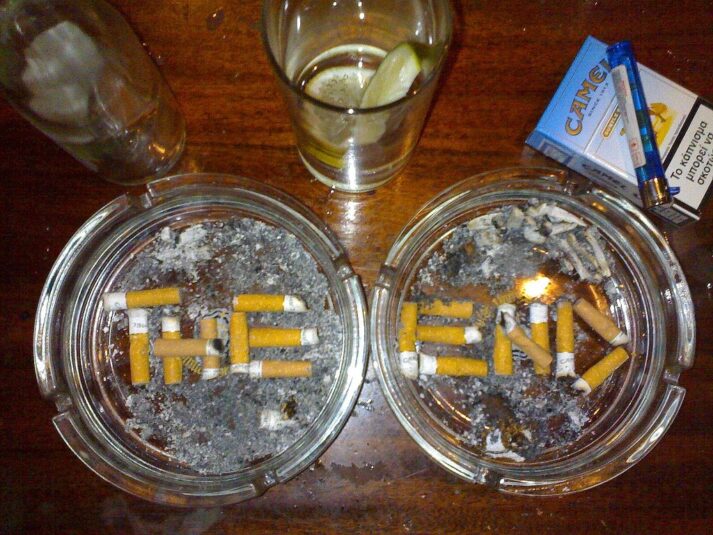
Why can’t we just tell the truth, people?
We talk a lot about a nefarious shadow organization making us fatter and lazier in our monthly story-driven adventure, Rising Heroes.
I thought it would be fun to create a dragon to slay. However, when you read that stuff above about:
scientists being paid off
calorie sugar bombs being marketed as healthy
companies claiming “there’s no way anybody could consider these drinks healthy,”
It’s like there really is a conglomeration of bad guys aiming to make us unhealthy.
Here’s how you can fight back. Follow these 4 quick rules to keep sugar from ruining your life:
1) Whenever possible, minimize liquid calories. This includes frappucinos and sodas, but also “real fruit smoothies” and “healthy” Naked Juice drinks, Gatorade, and even things like apple juice, orange juice, grape juice, cranberry juice, etc. Every once in a while? Sure. Just make it a rare treat (“treat yo’ self!”) – you’ll actually enjoy it more and be healthier!
I personally prescribe to the “out of sight, out of mind” philosophy because I have the willpower and restraint of a 5-year kid in a candy store. I don’t keep sugary beverages in my house so I’m not tempted and have to waste willpower trying not to drink them.
I’ve found that drinking sparkling water like LaCroix can really help me THINK I’m drinking soda, and provide me with the same level of happiness and fizzy satisfaction – without the sugar.
2) Don’t trust the front of the label, and learn to recognize sugar’s aliases. A label is required to list ingredients by amount, so by adding multiple types of sugar with weird names, a company can get away with moving sugar down the list.
Look for the following names: Agave nectar, Brown sugar, Cane crystals, Cane sugar, Corn sweetener, Corn syrup, Crystalline fructose, Dextrose, Evaporated cane juice, Organic evaporated cane juice, Fructose, Fruit juice concentrate, Glucose, High-fructose corn syrup, Honey, Invert sugar, Lactose, Maltose, Malt syrup, Molasses, Raw sugar, Sucrose, Sugar Syrup.
If you only look at two numbers on the back of a box, look at grams of sugar and total calories. You want minimal sugar and fewer calories. Don’t let perfect be the enemy of good. Do the best you can!
Oh, and if a product says “no sugar added” on the front of it, you can bet your life savings on it having a RIDICULOUS amount of sugar.
Note: please don’t bet your life savings on this.
3) Be skeptical, because sugar is in practically everything. When in doubt, eat things with fewer ingredients. We consume 130 pounds of sugar per year on average (holy crap), which means the white stuff in in way more foods than we realize. Not just candy and soda, but practically everything.
Nature Valley Granola Bars? Plenty of sugar. In fact, most “protein bars” have tons of sugar. And, until outraged customers complained, “Nature Valley” Granola Bars were made with high fructose corn syrup. Mmmm, nature.
Pasta sauce? Should just be tomatoes right? Nope. Add in heaping tablespoons of high fructose corn syrup too and you’re getting closer.
Wheat bread? That’s gotta be healthy, right? Check the ingredients. I bet one of the top 5 is “high fructose corn syrup” too.
Hell, look at what’s advertised as a “balanced breakfast” these days on TV! Cereal and skim milk, fruit, a glass of orange juice, and toast. Or, in other words: sugar and sugar water, sugar, sugar water, and pile-o-carbs.
4) Track your sugar intake, and minimize it over time. As I cover in “Star Wars Explains Why We’re Fat,” everybody has a different amount of “gimme gimme gimme” in our brains that craves instant gratification.
This means we all have different abilities to get addicted to things, including sugar. Some people can eat sugar (or have one drink, or try drugs) and not get hooked, while others struggle with addiction instantly – once is enough to get hooked for life.
If you are somebody who is actually hooked on sugar, start by tracking your sugar intake each day (actually look up the sugar content of everything you consume!), and see how many grams you’re eating every day. Don’t worry about total numbers, just focus on eating less sugar than the day before. Repeat.
Michael Pollan, author of the Omnivore’s Dilemma said it succinctly: “Eat food, not too much, mostly plants.” Eat real food (meat, vegetables, unprocessed stuff), keep your calorie total down, and stick to mostly plants along with healthy protein. Done!
We’ll continue digging into this battle against Big Sugar, shadow organizations, and false advertising in future posts. It’s amazing how heavily the deck is stacked against us when we try to be healthy, and how tough it is to find the actual truth!
I have no problem with sugar and people making choices that don’t line up with their health goals occasionally.
What really grinds my gears is when sugar is snuck into products and falsely marketed as healthy. We’re going to fight, and it starts by educating ourselves on how much sugar we’re actually eating.
Over the next week, your mission is to read the labels on the food and beverages you’re consuming. Specifically keep an eye on how many grams of sugar you’re consuming. Then over the next few weeks, try to drop that amount down by 10% each week. And then let me know how you did!
I want to hear from you: did you find this post useful? Hit reply and let me know if this article is actually gonna help you start to remove more sugar from your life!
-Steve
PS: We’ve recently overhauled our monthly story-driven experience, Rising Heroes. We’ll be opening doors for it next Monday, a few weeks later than normal – if you were waiting to get in, sorry for the delay. I promise it’ll be worth it – we’ve unrolled some big updates! 🙂
PPS:If you want to learn about the history of sugar and a contrarian viewpoint to “calories in, calories out no matter what they are,” check out Taube’s book “The Case Against Sugar.” It’s thought provoking and entertaining.
This is an article from Team NF’s Mental Health Professional (and father of 3), Dan Schmidt.
Ever heard of “living in the moment,” been told to “stop and smell the roses,” or to just “go with the flow”?
Nothing but a bunch of tired clichés, constantly reworded slightly to clog up our Instagram and Facebook feeds by old acquaintances and weird relatives, right?
Perhaps, but there may be much more to these trite sayings than we think.
Do you ever pause a video game in the middle of a crucial point or battle just so you can “gather your thoughts” and “calm your nerves”? Just silencing your mind and focusing for a brief moment can really help you out.
You may not know it, but in a situation like this, you’ve just practiced something called “mindfulness,” a mental technique which enables you to handle problems better and reduce stress through balancing your emotions and mind.
Mindfulness is all the rage at the moment, but is it simply a cleverly marketed fad fuelled by hashtags and dodgy life coaches, or something that can perhaps help us on our quest to level up our lives?
So, if you don’t mind (get it?), let’s find out.
What the hell is mindfulness?
As with many “new-age” practices, the concept of mindfulness has actually been around for thousands of years. For us humans, thinking is kind of our thing.
It’s an incredibly simple, yet challenging, mental technique adapted from Buddhist practice to now suit non-religious contexts. Some people assume it’s about clearing your head and thinking about thinking “NOTHING.”
It’s actually more about stepping back and hearing your thoughts without judgment with a relaxed, focused mind.
“So what actually is it?”
Basically, mindfulness is just being aware of what you are doing, when you are doing it, and becoming a master of your mind, rather than being controlled by your subconscious impulses.
Even as you’re skimming through this article, how many other things do you have rushing through your head right now?
Worrying about the future or dwelling on the past?
Our world and lives keep getting busier and more ‘urgent’ (thanks to our phones and the internet), and as a result, so do our minds. Our thoughts and feelings are constantly moving from one thing to the next without a moment’s rest.
That’s right, nearly half of our waking lives, we’ve got our minds on something else. Yeah, physically I’m reading the same freaking book to my kids for the 80th time, but I’m actually on auto-pilot thinking about my work deadlines. The next day I’m at work trying to meet those deadlines, but I’m now mentally planning the weekend with the kids.
It’s like that YouTube rabbithole we’ve all been down. You might have started searching for “how to do a push-up” and then all of a sudden it’s 2am and you’re watching an instructional video on how to ride a unicycle and you don’t even own a unicycle.
It’s like parts of our brain and bodies are at odds with the other parts.
If you want to level up your brain, spend better quality time with your loved ones, improve your work life, family life, and love life, it starts with developing mindfulness.
Don’t believe me? Ouch. That’s okay, I’ll give you the science because I’m nice like that.
Does mindfulness actually work?
“Will this practice actually achieve anything, or is this just another waste of time mixed with pseudoscience and inspirational instagram quotes?”
Great question – what kind of NF Rebel would you be if you weren’t also skeptical and demanding proof?!
A wholelotofevidence–basedresearch has shown consistent, reliable, and reproducible results that mindfulness has a huge range of health and psychological benefits. It’s been around for ages and been a part of psychological therapies since the 70’s: there’s no denying it, it’s not going away anytime soon, and the benefits are astounding.
Supporting the brain’s capacity to stay focused on what you are doing, as you are doing it, can help you in so many ways, including:
Stress relief
Building resilience
Regulating mood
Overcoming addiction
Improving sleep
Managing depression and/or anxiety
Increasing focus, concentration and learning capacity
Reducing heart rate
Improving immunity
Boosting happiness
So, want a better quality of life, without having to spend anything, go anywhere, or really even do anything? Why not give mindfulness a shot if you haven’t already?
With a little bit of patience, regularly practicing mindfulness for just a few minutes each day can improve your happiness and help you better cope with whatever life throws at you (even if it’s a blue shell).
Practicing mindfulness regularly reminds us that underneath our troubling emotions and negative thoughts is a deep sense of calm, joy and peace.
Where is my mind?
Stop and take a moment, right now. Ask yourself, as the Pixies did: “Where is my mind?”
Focus on this moment in your life, right now. Be present. Take notice of your posture, your breathing, the font of the words you are reading. Let your thoughts about this moment come to you, and listen to them without judgment.
Just focus on what you are doing, and ONLY that thing, right now. Just do it for a few seconds.
Congratulations, you’ve now practiced mindfulness. INT + 1.
Incredibly simple, but when practicing it for more than a few moments, it can be difficult to keep your mind from wandering. It’s like trying to herd monkeys hopped up on Mountain Dew, in a rainstorm, blindfolded.
At least, that’s what it’s like for me most of the time.
Think of it this way: As Jonathan Haidt puts it, you are a rider (your rational brain) atop an elephant (your emotional/subconscious side) – you do your best to guide the elephant and work with it, but it often does what it wants to do:
If you struggle with keeping your focus on something for more than a few seconds, you’re not alone. That device in your pocket is designed to distract you every 5 seconds, we’re in the age of RIGHT NOW and INSTANT, and every type of entertainment you need is within arm’s reach thanks to technology.
Here’s how you can start and develop your mindfulness practice, thanks to an amazing 80’s comedy.
Be the ball, Danny
Due to its simplicity, how one practices and gets the most out of mindfulness is really dependent on the individual. Some practice full-on meditation (more on that later), Nerd Fitness Yoga (or mindful movement), affirmations, breathing exercises, relaxation techniques or they simply find a quiet moment to themselves.
For me, whenever I have the time, or get stressed (which, with three young children, is more often than not), I get in touch with some advice from the sophisticated highbrow cinematic masterpiece, and my favorite movie of all time, Caddyshack:
Ty Webb, played by Chevy Chase, perfectly sums up mindfulness in a way I can understand with his golfer’s approach on Eastern Philosophy:
“Just relax. Stop thinking. Let things happen. Find your center. Be the ball.”
Just relax – Get comfortable and focus on your breathing.
Stop thinking – (Not completely) try to keep your thoughts from wandering away.
Let things happen – Let your thoughts come to you, and listen without judgment.
Listen to your mind. Be calm, fully aware of why you’re doing what you’re doing.
Be the ball – Keep focused on the present moment.
For me, “be the ball” is all about staying focused on what I am doing, as I am doing it. Initially, “be the ball” just started with my golf game. Instead of overthinking my swing, I deliberately wouldn’t address the ball until I had cleared all thoughts from my head and JUST focused on the shot in front of me.
Over time, I started applying my “be the ball” concepts to other aspects of my life like study and work, and found it was an extremely powerful antidote to keep my easily distractible mind focused on what I needed to be doing.
When practiced regularly, I’ve found mindfulness brings more calm and focus into my insanely busy life, while also reducing stress and building efficiency.
Want a more direct benefit? You’ll eat less!
Studies have shown that people who eat mindlessly (while watching a movie or a TV show, scrolling through their phones, or playing a game) consume significantly MORE calories than people who just eat (meaning they are sitting at a table, eating food, and not doing anything else).
Me-di-tate, good times, c’mon!
“Deep inner sense of calm and peace? So, it’s like meditation, right? Like Dhalsim in Street Fighter?”
Well, kind of… Mindfulness is classified as a form of meditation, yes, but “meditation” is a large umbrella term that encompasses and broadly groups together a wide range of practices under one label, which is handy from a language perspective, but can become confusing when talking about specifics.
For example, if you met someone who said “I enjoy fitness,” does this mean they like running, lifting, walking, hiking, sports or pilates? Or, if you’re “really into gaming,” does this mean video games, tabletop, small Austrian villages, role-playing, or even gambling?
Meditation (which we’ve covered really well here at Nerd Fitness) is really broad, whereas mindfulness is quite specific. They are certainly complementary, and there is some overlap between the two, but I like to think of mindfulness almost as “gateway meditation” or “casual meditation.”
Many who start with mindfulness may go on to explore more about meditation if they’re looking to delve in even deeper, but others like myself are quite content with our mindful moments.
If someone asked me if I meditate, I’d say no. I don’t “meditate” in the traditional sense; I guess I’m channelling my inner Ron Swanson here.
I don’t own a special cushion or one of those cool little benches, I’m not an overly spiritual or religious person, I’m not keen on crossing my legs for lengthy periods, and the smell of incense just reminds me of being hungover in Thailand.
But do I regularly exercise my mind for psychological and physical benefit? Hell yeah. It’s easy, free, convenient, beneficial and I can even do it on a plane, train, or automobile.
Now I’m certainly not trying to downplay meditation as a whole here at all (shoutout to all our rad Druids), as it’s proven that meditation is extremely powerful. Just know that you don’t need to meditate to practice mindfulness.
There are many ways you can increase your mindfulness in day-to-day life. This could be through specific activities like yoga, golf (my favorite) and art, or even by just paying more attention during regular daily activities like reading, cooking, walking, driving, eating or something as basic doing the dishes.
Regardless of the activity, just remember, mindfulness is simply awareness of the present moment. You can be mindful anytime, anywhere.
Start being more mindful today!
Mindfulness is something that everyone can develop, and it’s something that anyone can try. I’m racking my brain right now to think of an actual decent reason not to at least try it and I’m coming up empty. The mind is like a muscle, and just like we exercise and eat healthy to keep our bodies fit, practicing mindfulness is a way of keeping our brain fit and healthy too.
Let’s not allow important life moments to get away from us. Mindfulness keeps us focused when we need to be, and the benefits are amazing. Best of all, you can start right freaking now! (Well, maybe finish reading this first.)
Start practicing today by being mindful:
Simply take a few deep breaths
Go for a walk outside
Choose a natural object from within your immediate environment and just focus on watching it for a minute or two
Start to levitate (kidding)
A good place to start: notice a flower, the clouds, a tree, anything…perhaps not the sun though:
Try not to do anything except notice the thing you are looking at. Look at it as if you are seeing it for the first time. Carefully study every aspect of its configuration and just become momentarily consumed by it.
If you haven’t done it before, it’s initially a very strange experience. I totally agree with those of you thinking that this sounds like a bunch of hippie crap (once again, sorry Druids), but it can really help your brain reboot and become more focused and aware.
Give it a few minutes each day to begin with, that’s all we ask.
I’m not going to promise you that it will totally change your world and solve all your problems. In fact, it probably won’t.
OR WILL IT?!!?!?
No, probably not.
But it will open up the opportunity to get a different perspective on what is happening in your life. We can’t change everything that happens in our life, but we can change how we think about it, and with a strong mind, doing that becomes much easier.
Mindfulness is also a really personal experience; it can’t be guided by a scripture or orders. It can be introduced to a person by another who can explain its purpose and intention, like I may be doing for you now, but no one can direct you how to practice. That’s entirely up to you. Just try anything for a week and let us know how it goes.
So what have you got to lose?
Mindfulness is a positive, practical, easy and scientifically proven technique. It’s amazingly self-empowering to be aware of your experiences and see them for what they actually are, rather than getting caught up in the story behind them, which can often lead to mental health issues. Mindfulness is about letting go of the past (much like Nerd Fitness’ “We don’t care where you came from…”), focusing on the here and now and not stressing about the future.
The Mindful Eating Challenge
My dear nerdy friend, go forth and be mindful. With mindfulness becoming more prevalent, there’s a bunch of great mindfulness apps with programs to follow if you’re looking for some extra guidance.
So give it a try: whether it’s through full-on meditation, a guided app, “be the ball,” or simply by taking a more mindful approach to everyday activities like eating, the practice of mindfulness really can actively improve your life.
To make this more practical and concrete, I’m going to issue you a challenge:
During your next meal (or snack), I want you to ONLY eat.
Not “eat AND [insert activity]. Just eat:
No watching TV while eating.
No scrolling through your phone while eating.
No reading a book while eating.
Focus on the food in front of you, the person across from you if you are eating with somebody, and think about each bite you take.
That’s it.
Now, depending on how often you “eat AND [activity],” this could be brutally difficult.
Making this ONE change – only allowing yourself to eat without doing something else – could have dramatically positive consequences on your health. If you’re a mindless snacker, you can only ‘eat my snack’ without surfing the internet or watching tv.
If you always eat your meals in front of the TV, turn it off, and focus on the food you’re consuming.
A few months back, a group of my friends and I engaged in a digital arms race. You see, I made the horribly amazing mistake of downloading the brutally difficult and perfectly balanced mobile game, “Geometry Dash.”
Your goal is to get your automatically moving square to hop over increasingly challenging triangles and boxes by touching the screen. I know, squares hopping over triangles sounds like thrilling game mechanics.
No joke, I’m warning you to NOT download this game:
You’ll swear words you’ve never said before, you’ll pull your hair out, and then you’ll say “one more try.” And you will do this thousands of times When you finally beat a level, the sheer joy you’ll experience is unparalleled, only to repeat the process on the next level.
Although the game took over my life for a few weeks, it taught me a valuable lesson about the positive benefits of peer pressure. Today, you’re going to learn how to enter your own arms race with your friends and use peer pressure to positively level up your life.
With us opening the doors for a few days to our monthly team-based, story-driven, habit creating fitness adventure Rising Heroes today, I want to talk about the power of teamwork and peer pressure!
Geometry Dash Teaches me a Life Lesson
So, about that aforementioned Geometry Dash…
Within 5 minutes of playing for the first time, I was hooked. I quickly fired off a text to my text chain with my close friends from high school and college (Joe, Cash, Saint, Eric, and Helder), told them to drop what they were doing, and download this game.
Reluctantly they did, and then I ruined all of their lives:
“This game is stupid….but I can’t stop playing.”
“I’m almost done with level 1, but that damn last jump!”
“Just made it to level 2, BOOM. Ugh that was tough.”
“Wait I’m still stuck on Level 1, give me an hour.”
“Just cleared level 3! If you’re stuck on level 2 you’re a loser!”
Day after day, for weeks, the above scenario would play itself out. Some nights I’d go to bed relieved that I finally beat a level and I could move on with my life, only to wake up to a text from Cash who had beat the next level. You could hear my groan from outer space as my competitive brain said: “Steve! You can’t get left behind! If he beat that level, so can you. Go go go!”
I’ve uninstalled and reinstalled the game at least two dozen times, each time believing I’m free of its grasp…only to get sucked back in with a single text or screenshot from Cash or Joe or Saint who advanced farther than I did.
And thus I would re-download the game, spend hours trying to beat a stupid level, get past everybody else, and then share with the group that I’ve succeeded and thus no longer deserving of torment or good natured ridicule.
I was in the gym the other day, in between deadlift sets, trying to beat the 11th level in Geometry Dash, an idea popped in my head: Why don’t I take the Geometry Dash mechanic and apply positive peer pressure to my life in a HEALTHY way?
Positive Peer Pressure Proves Powerful
“You are the average of the five people you associate most with.” -somebody way smarter and more successful and probably with better hair than me.
We all have people in our lives that we want to see succeed (at least I hope!), and they want us to succeed too: be it with weight loss goals or building gym habits or advancing in our careers.
If you don’t have that at home IRL, maybe you have made friends with members of the Nerd Fitness community through the free message board community or one of our courses.
I’ve come to learn something pretty powerful about the differences between people who struggle for years and years to get in shape, and those that find a way to crack the code and find permanent success!
With few exceptions for either group:
Those who struggle are often alone in their journey. They have nobody cheering them on, nobody keeping them accountable, nobody to support them. They do something AMAZING (getting their first pull-up, doing a handstand for the first time, or running a mile non-stop), and they don’t have anybody to share this with! This is a lonely road that is littered with optimistic people who started off strong but ran out of steam when the going got tough. It happens to the best of us
Those who succeed are part of a group. And not just any group – but a ground that inadvertently challenges them to be better. It’s the videogame equivalent of grouping up with people a few levels above you: they make the game more enjoyable and you get better! The people who succeed have squadmates that keep them accountable: regular check-ins, support, and somebody to call them on their bullshit when they make up an excuse why they missed their workouts!
Now, I would imagine that many in the first category actually have plenty of important folks in their lives, who care about them and want to hang out – but because this group isn’t interested in getting in shape, the ‘peer pressure’ is of the “hey let’s go out drinking! Skip your workout!” or “skip your run tomorrow am, we’re firing up another game of Overwatch!” variety.
Peer pressure can be negative, especially when you’re not getting support as you try to better yourself! My friends and I used peer pressure in a harmless way to encourage each other to beat levels in a video game – though it ended up taking up hours of our lives.
Not ideal!
However, what if we turned the tables? What if the peer pressure was used in a good natured and positive way to get your group of friends to do fun challenges throughout the day to better their lives?
You probably see where I’m going with this…
Create Your Squad, Start Daily Challenges Today
You’re going to create a squad, and you’re going to challenge each other in an arms race to see who can live healthier or happier.
Here’s what you need to do to use peer pressure:
1) FORM YOUR SQUAD: You need a few good men/women (or self-aware robots) that are interested in taking up this cause with you. If they don’t know what you’re talking about, have them read this article: Start a Facebook group, text chain, Slack group, whatever you like with 4-5 of your friends or coworkers that you know are interested in living healthier lives. Your group should be at least 3 people, but I find that 5-6 is the sweet spot for participation.
2) Determine the ground rules. Your goal here will be to come up with a series of challenges that can be done anywhere, at any point in the day, in less than 5 minutes. This might depend on the healthiness and level of fitness of your group members.
Here are 5 examples:
“Went for a mile walk this morning before work.” with a picture of your feet on the pavement. Everybody else in the group then needs to share a photo of themselves completing their mile walk before noon.
“Just did 20 air squats in my cubicle, last one to do 20 has to do a lap around the office. “Oh yea? Just did 25, cute that you could only get 20 done though!”
“Took the stairs up to the 16th floor, you can’t use the elevator for the rest of the day or you owe everybody 5 bucks.”
“Did 10 push ups waiting for the bus to show up, second person to report in has to do 11, third has to do 12, fourth has to do 13, last has to do 20!”
Think of things that are challenging for your group, but done in a fun way. I would recommend something like: you can only declare one rule per person per day, 3 rules per day for the group at the most, and you can’t have more than one rule in an hour.
The point isn’t necessarily to exhaust each other or make the challenge brutally difficult, but rather to get you to increase your “Actions Per Day,” (aka increase the number of healthy choices you make in a day) as we’ve seen the higher the number of APD people take, the more likely they are to be fit!
4) One-up, make fun, repeat. If you can’t make fun of your friends, what’s the point? Feel free to groan loudly at the person who did the task, and make fun of them as well – whoever makes the declaration gets to pick it. If they do it, you can one-up them by completing an extra rep or climbing a floor higher…someway to outdo them.
Feel free to use the following terms in your insults as you text back and forth throughout the day when you outgun your friends:
Scruffy-looking nerfherder
Scalawag
Cotton-headed ninny muggins
Ragamuffin
Amoeba
Hooligan
Asshat
After all, what other name is there when you you wake up at 6:30, only to have text already in the group:
“Already walked a mile today. Walk a mile before work or you owe $5 to [stupid cause].
“Walked a mile, did 5 push-ups. Ain’t no thang. Hey Mike you’re up next.”
“I hate you asshats. Just did the mile, and 10 push-ups. Ugh.”
Squad Up, Tips and Tricks
Here’s another list of tasks and ideas you can use in your squad:
1) Add points, keep track of them month to month. Keep it simple. Everybody gets a column on a spreadsheet, complete your mission, you get a point. Most points at the end of the month wins the pot.
2) Add accountability. The quality of your squad race here will be largely dependant on the participation of the group. You need to have people that are invested, and the best way I’ve found to do that is to make people pony up cold-hard cash. Have everybody in the group contribute $50. Any time somebody misses a challenge, $5 of that money gets split amongst the others.
Diabolical? Donate that $5 to the charity that person hates the most!
3) Pick fun, healthy missions that your friends will loathe (but still do!), and then return the favor on the next day. Quick fitness challenges are fun, but you can expand it to include nutrition or even fear-based challenges too if you want to double down on the healthiness.
“Eating an apple you can’t use the vending machine at work or you owe 5 bucks! (nobody will like you for this one, muahahahaha) Just asked my boss for a raise, you have to do something that scares you within the next 48 hours! Report back with your results.”
“Push-up challenge: as many in a row, right now, wherever you are. Get whoever to record you. You have 30 minutes.”
“Climb all the stairs in the building you’re currently in, no matter how many floors. Take a photo next to sign in stairwell. Better hope you’re not in the Empire State Building!”
“Actually made my own damn dinner tonight. You have 48 hours to actually make yourself a meal – microwave pizza doesn’t count…needs to have at least one vegetable!”
Create your squad today
My friends and I have done this with a simple text chain and some good natured ribbing. You do NOT need to overcomplicate this! To recap:
Recruit a group of 5 of your friends, either in real life or from the Nerd Fitness Community
Come up with a list of some fun basic missions you can complete that make you live better, but can be done anytime, anywhere.
Add accountability, and come up with the first challenge you’ll complete
Whenever anybody proposes and completes a task, find a way to one-up them and yell at them.
Repeat
Profit. I mean, get in shape 🙂
Now, I’d be remiss if I didn’t mention the fact that we actually have a whole squad system built out in our monthly, story-driven, team-based fitness adventure, Rising Heroes. You can simply click a button and be assigned to a squad of five where you can start supporting each other today! Here’s one such group looking for one more…
I’ve seen some pretty epic friendships come out of this experience, so if you don’t have a group in your life that is pushing you to be better and keep you accountable, this could be the thing you’re looking for!
I’d love to expand upon the examples I share above, leave a comment below with a fun, quick challenging mission you can challenge your friends to complete no matter where they are in their day.
Anytime you can get people climbing stairs or doing push-ups in their cubicle or air squats in their bathroom stall is a good day, in my book!
Leave a comment below, we’ll pick a winner at random and hook em up with a free month of Rising Heroes!
-Steve
PS: Because everybody goes through the story together so they can work together, Rising Heroes enrollment is open until Thursday at 11:59pm EST.
Welcome to the quirkiest, most supportive community on the Internet.
If you consider yourself a nerd, misfit, mutant, oddball, goof, or somebody that doesn’t quite fit the mold, you’ve come to the right place.
If you’re interested in living a better life but can’t seem to find others that think the way you do or want the same things you do, I want you to know two things:
You are never alone.
Welcome home.
Whether you’ve been reading this site for a day or 8+ years (hi mom), I appreciate you. Whether you just want to eat better and learn how to do pushups, or you’re interested in deep diving into a community that encourages both healthy and nerdy behavior equally, I’m thankful you’re here.
Actually, the fact that anybody is here is very exciting to me. I started this site in 2008 simply because I couldn’t find anything like it on the internet: a home for nerds that provided no-nonsense, unbiased fitness information. Since then, Nerd Fitness has taken on a life of its own and I couldn’t be more proud of the quality and caliber of the people who embody the NF philosophies and ideals.
This past fall, we had 450 misfits and mutants from 10+ countries attend Camp Nerd Fitness (our big in-person event), and it felt like a giant family reunion. Whether it was people that had been to Camp NF previously, or newbies meeting other members of the community for the first time, it cemented how powerful this community/force-of-nature has become.
People have gotten married as a result of meeting at Camp NF. At least 4 people have the NF logo tattooed on themselves (shout-outs to Amanda M, Chris J, Chris P, and Hannah P). There are 100+ member-led Nerd Fitness groups throughout the world.
I feel very fortunate to be part of such a special group of people, and today I want to invite you to get more involved. I know only good things can come of this 🙂
Welcome home.
Xavier’s School for Gifted Youngsters.
Hogwarts School of Witchcraft and Wizardry.
The Island of Misfit Toys.
The Nerd Fitness Rebellion?
I started Nerd Fitness as a simple blog back in 2009 – I published articles about push-ups, Star Wars, vegetables, and LEGO, trying my best to help other nerds get started with exercise or eating slightly better. I hoped one day this side-project hobby could become my day job and support me financially so I could focus on it. I never expected it to become a community of people that I would lean on emotionally!
Somebody at Camp NF last year said something that I’ve taken to heart: “Come for the push-ups, stay for the feels.”
We know a lot of people stumble upon Nerd Fitness through an unemotional topic like a Beginner Bodyweight Workout or the Paleo Diet or Intermittent Fasting, but it isn’t just the information that keeps them around: it’s the camaraderie of the community that ends up keeping them here for years.
I’ve been thinking a lot about why and how the Nerd Fitness Rebellion became what it is, and I think it’s because we’re all a bunch of weirdos that never get to truly be ourselves.
We often don’t get to nerd out about our favorite nerd things with our work friends. At the same time, we don’t get to be our true selves amongst some of our nerdy friends either! They’re not interested (yet) in getting healthier, and they don’t understand that we can’t start up another game of D&D or Overwatch because we have an early run or workout the next morning.
You might be working on getting in shape, but you’re intimidated by training in a commercial gym full of good looking in-shape people. Maybe you’re sick of getting bombarded with “fitspiration” ads on Instagram that show a genetically flawless person who is promoting supplements or skinny tea or cleanses.
You might feel like you’re on your own island, alone on this journey, with nobody that understands your struggles, supports your passions, and gives you permission to both love yourself AND want more for yourself.
This is what the Nerd Fitness Rebellion (our community name, paying homage to the Star Wars rebel alliance) represents: A place you get to be 100% yourself.
You can debate Star Trek vs Star Wars, discuss which Brandon Sanderson series you like the best, join a crochet group, write fan fiction as a group, or anything in between, and be heralded for your nerdy quirks.
People joked at Camp NF, after they had crowd-surfed me against my will (all in good fun though), that I had become the accidental leader of an actual cult.
I laughed and shrugged it off, and then I looked around at one group of people training with swords, another group scaling a wall, another breaking boards, another playing board games, and hundreds rocking the Nerd Fitness logo on their chests, cheering for everybody with passion, and I realized something:
We’re not a cult…we’re an army!
An army of passionate people dedicated to helping each other live a happier, healthier life.
And we need your help!
How to get involved with Nerd FItness
“Steve, I read your emails, and I’ve done the bodyweight workout, but this Rebellion thing sounds kind of fun. How do I get involved?”
You might be asking yourself this right now.
That is a fantastic question! Also, you look nice today.
Let me break down the different places you can get more involved and supported by this community.
Free Nerd Fitness Message Boards: We have a free message board community that’s home to tens of thousands of members from all over the planet. We’re lucky to have 40+ volunteer moderators that help keep the community rocking and rolling.
A quick note that your Message Board account is different than the NF Character account you might have made (or you might have if you own one of our products). If you look at the message boards and get overwhelmed, it’s okay! Start here, introduce yourself, and begin sharing your stories and struggles.
Community-Led Facebook Groups: Thanks to the growth of Facebook, although we do have an official Nerd Fitness page and private Facebook groups for each of our paid products or experiences (Camp, Rising Heroes, Academy, Yoga, Rings and Handstands), many community members have taken it upon themselves to set up their own Facebook groups for certain things as well.
Many people in these groups coordinate regular meetups or events, and I cannot tell you how cool that is for me. Here are just SOME of the communities, some based around geographical locations or others based on interests.
A simple search on Facebook for a city or state and Nerd Fitness should reveal a group you might be on the hunt for!
What’s that? You don’t see a group for your particular special interest or location? Make one! Post a comment on this post, join the Message Boards and let people know you’re starting a group, share it with the community, leave it as a comment in this article, and get your group up and running! It only takes two to tango!
What’s that? You want to host a meet-up? Go for it, and let us know so we can share the details! I know the Austin NF group, the Boston group, Europe, and Aussies get together at least a few times a year, and it’s all community-led.
We hope to be able to support and make these groups and events more official in the future, but for the time being I am so thankful for the men and women and robots that have set up these groups and are embracing the NF Rebellion, hosting events, and facilitating the support. You have my thanks.
Who works for Team Nerd Fitness?
Although Nerd Fitness started as a part-time hobby that I worked on after my day job every night, it’s really become a beast to manage and support.
We now have 9 full-time employees (that live in 9 different states) and a dozen contractors that work all day to improve the experience around here!
You probably know some of them:
Staci Ardison was a community member who found NF at a low point in her life (and chain smoked 2 packs of cigarettes a day) and now deadlifts 430 pounds. She also champions our community to the world and encourages women to not be afraid to lift heavy, teaches how to batch cook, and has the cutest dog on the planet. You should probably follow her on Instagram at @StaciArdison if you want to see deadlifts and doggies 🙂
Jim Bathurst taught me how to do handstands and muscle-ups back in 2011. A few years later, I sheepishly asked if he wanted to train our nerds at Camp NF, and then I learned that he’s even nerdier than I am! Since then, Jim has joined the team full time and creates workout experiences and provides expert fitness advice to our communities. He also has an amazing dog named Scooter, and you should follow both Jim (@BeastSkills) and Scooter (@ScooterpomDC).
In addition to those two knuckleheads above, we have a ton of people that operate behind the scenes. From Darryl who does all of our design to Alek who builds all of our websites, Baker who develops our products and coordinates everybody, and Lauren who runs Camp, we also have Noel who is helping take care of people in our monthly adventure Rising Heroes along with making sure our emails make it safely to your inboxes, and Simone who is in charge of Rebel Support.
Along with this full-time team, we also have a dozen contractors and partners that handle everything from HR to bookkeeping to accounting to forecasting to legal to servers to analytics and all of the other behind-the-scenes stuff. (All the adult stuff, gross.)
I wanted to share with you these things for a few reasons:
Nearly everybody on Team NF is somebody that started as a community member at Nerd Fitness. They were asked to join the team thanks to their commitment to improving the lives of those around them, doing so just because they wanted to. These are people leveling up their lives too, and their infectious and supportive behavior is what makes them great Team NF Members.
We’re just like you: misfits and oddballs and goofs who are trying to figure out life, fitness, and business. Nerd Fitness has been bootstrapped since day one (my initial investment was $100 to buy a domain and a year of hosting), and our focus is on creating an experience and environment that helps you live better.
Depending on how long you’ve been reading Nerd Fitness, you might not be aware of some of the following:
1) There are purposefully no ads on Nerd Fitness. Before I started this site, I really struggled to find a fitness website that gave me honest information. Most of them tried to sell me on proprietary workouts (scientists hate this one weird trick!), supplements (fat blaster!), or shamed me into thinking I was unworthy unless I joined their service.
There are no ads on Nerd Fitness because I want you to know the information presented here is unbiased and untainted by advertising dollars.
I have no problems with companies needing to make a living; I just wanted Nerd Fitness to be a safe haven from all of that stuff. If you read something on Nerd Fitness, it’s because we believe in it wholeheartedly, we’ve experimented on ourselves and can share the results, or we’ve seen the strategy work for OUR people (busy nerds who struggle with their health).
This might lead you to ask the question: “Steve, how do you pay 9 people and 12 contractors if there are no ads?”
2) Nerd Fitness builds its own courses and experiences. Nerd Fitness is both a community and a business. We know that probably 95% of people that read this site or join our community will never buy anything we sell, and that’s okay!
At the same time, we have built some damn good products and experiences that have helped tens of thousands of customers dramatically transform their lives.
We know not everybody can afford them, which is why we offer everything else on this site for free and ad-free. We have published 800+ free articles, we have free message boards, encourage free community-led events, and more.
We are confident that the free stuff we offer is better than most people’s paid offerings, and that our paid experiences or products are a better value than anything out there in the fitness space.
In short, we create things that get results for our people. We break down the problems busy nerds have, and create experiences – both digital and in person – that remove all barriers between that person and success.
When we put out something new, we’re going to tell you about it! We believe very strongly that our products are the best in the industry, and that they will get you the results you’re after in the environment you need to succeed – provided you follow the instructions and do the work (which is always the tough part)!
Right now, the things we have for sale:
The Nerd Fitness Academy: Think of this like a digital bootcamp for the first 12 months of your fitness journey. The Academy includes quests, workouts, nutritional plans, and mindset strategies to finally overcome the obstacles of getting in shape.
Rising Heroes: Our monthly habit-building, team-based, story-driven adventure. We open the doors to enlist for a few days each month and take the entire community through an experience that changes based on the actions the group takes or the decisions made from week to week. Doors open again next week for a few days!
Nerd Fitness Yoga: Yoga for people who don’t do yoga. 🙂 If you have a sore back, poor posture, or you just want to finally be able to touch your toes, NF Yoga is your thing. No zen or woo-woo stuff, just fun approachable routines you can follow in the comfort of your home (or download and watch anywhere) with the NF Style you love.
Nerd Fitness Rings and Nerd Fitness Handstands: A beginner’s guide to getting you from doing simple movements to advanced movements like handstands, front levers, and muscle-ups. We built a proprietary leveling system to let you know exactly when to level up for each movement so you always know what to do next.
Camp Nerd Fitness (next Camp in 2018): An in-person, long weekend experience of training, costume parties, gaming, and everything in between. I could try to explain it to you, and this video does a pretty damn good job, but you really have to experience it in person. 🙂
Here’s something super important to know: we don’t think every person should join every single premium experience we offer! We also don’t think they’re courses “that scientists don’t want you to know about!” We don’t build our courses or communities like this.
Instead, we believe this should be a choose-your-own-adventure, and that our courses might be a good fit to help you get to where you want to go. Our goal is that anything we build for sale solves a specific set of problems for rebels in a specific situation.
Many people do love the Academy for their mindset, diet, and workout quests – but on their off days love to pop on one of the NF Yoga videos and stretch their sore muscles. It’s great that these work together for many people, but no single course is required for any other.
Obviously we’d love for you to check out the ones that pique your interest; it’s how we keep the lights on. Or don’t! That’s cool too 🙂
3) We’re a small team. We make mistakes! We spend all day every day trying to serve this community better.
This community is everything to me, it’s everything to our team, and I know it’s everything for a lot of people in it.
Every member of this team has the same passion and the same love for serving the Rebellion. We work hard to provide an amazing free community experience AND also be a valuable company that can sustain itself and grow the number of people our message can impact.
We read pretty much every email, facebook comment, thread, discussion, argument and success story that happens in our community.
Some people are fanatical about what we do and how we offer to help people. Other people would prefer that we take a different approach (in slightly less nice terms, ha!). It’s part of having a large, diverse community – and many members feel a BIG stake in the future of the Rebellion (and thus also have passionate opinions). It’s a good problem to have. 🙂
We have big plans to evolve, adapt, improve, change, fail, flop, grow, and learn in the coming years.
We’ll continue to provide free resources on topics that can help nerds around the world live happier, healthy lives. We’ll continue to invest in creating or improving premium experiences that a portion of our community embrace and leverage to get better, more sustainable results.
And we’ll also continue to mess up! And then we’ll continue to lean on the community for advice and suggestions on how to balance being a free, open, supportive community and a sustainable, long-term business.
No matter what your current role in the Rebellion is – new or old, active or passive, occasional article reader or member of several of our communities – you are welcome here.
And we hope you’ll reach out. Let us know what you are struggling with. Let us know what you love about the community or wish we could offer you in a better way.
You’re never alone
Harry potter lived under a staircase until he found his people at Hogwarts. Rogue struggled with her powers and identity until she discovered there was a school for people like her run by Professor Xavier.
Depending on where you are at in your life, what your job or family situation looks like, you might feel like a misfit toy or a mutant that is misunderstood.
I want you to know that you’re not alone. This community will welcome you with open arms, and do whatever we can to help you – as long as you are willing to commit to helping yourself too.
We know most people arrive on the proverbial doorsteps of the Nerd Fitness School for Gifted Youngsters with a lot of baggage: a rough upbringing, a shitty home situation, poor genetics, years of bad habits, and mental challenges that need to be overcome. Fighting these battles can be ugly, messy, and scary.
If you believe or embrace the following, we’re glad to have you:
We don’t care where you came from, only where you’re going. 400 pounds, 100 pounds, male, female, young, old, olympic athlete or newbie. Welcome. I don’t care what got you here, only how we can help you get you where you want to go.
We need to take personal responsibility. We all have baggage and crap we’re dealing with. Nerd Fitness and this community wants to help. It starts by accepting that no matter where you are in life, you and you alone are responsible for taking ownership and responsibility for that (even if it’s not your fault). This means you also already have all the tools and permission you need to change your life!
We don’t say “This doesn’t work for me because [excuse].” Instead, we say “Okay, this is my situation, how can I make this work for me?” It’s easy to take the easy path and decide your problems are unique and unsolvable…we don’t have room for those people! We are looking for people who step up and take the challenge: “Okay, I’m a single mom with 3 kids and 2 jobs and a busted leg…here’s how I can make this advice work for me.”
Play nice. We have a zero-tolerance policy for asshats – our moderators on the boards wield a heavy Ban Hammer 🙂 Remember that we all start somewhere, and that there are different ways to get in shape. We help those that want to be helped, but we don’t force our opinions on somebody that isn’t interested. Just because it’s the internet doesn’t mean you get to be a jerk. We have no problem telling people “thanks for being here up until now, but you need to find a new community moving forward.”
Ask for help. Whether it’s dealing with a mental illness, feeling silly for being afraid of going to the gym, or worrying about looking foolish when attending your first dance class, this is a community of people you can lean on. You will get out of it what you put into it.
TL:DR – Thank you for being here, for being weird, and for reading this. I hope you continue to be a part of this amazing group of people – in person or just online. Ask for help, and help those that ask.
In other words, come for the push-ups, stay for the feels 🙂
If you already have a NF Facebook group with at least 5 members in it, please leave a comment below with the link to it and what your group represents so others can join!
I’d love to hear from you: what makes you a unique member of Nerd Fitness?
Here’s mine again:
I nerd out passionately about video games, economics, playing music (piano, guitar, and violin), and for some reason think Taylor Swift’s “Blank Space” is one of the best songs of the past decade. I read 1-2 books per week. I break out into spontaneous solo dance parties and sing at the top of my lungs in my apartment at least once a week.
I also hit the gym four days a week. I’m working towards a 405 lb deadlift, a 60-second handstand, and can knock out sets of strict ring muscle-ups. I love discussing strength training tactics at the same time as discussing the brilliance of Zelda: Breath of the Wild.
This is an article from Team NF member Staci Ardison
Two thousand, two hundred and fifteen days.
That’s 316 weeks. 72 months. More than 6 years.
What’s the significance of these numbers?
This is how long, as of the time of my writing this, that it has been since I have smoked a cigarette.
We spend a lot of time talking about diet and exercise here on Nerd Fitness, but if you’re a smoker, quitting smoking is the best thing that you can do to level up your fitness.
Walking out of the gym and lighting up a cigarette (which I did more times than I’d like to admit) is definitely the opposite of the “post workout” recovery we are going for!
Now, I know what you’re saying: “Oh, please, not another boring article telling me the same things about how smoking is bad for me and that I should stop.”
I’m not going to do that to you.
It’s not a secret that smoking is bad for you. The box is littered with warnings and it’s not a disputed fact that smoking causes a magnitude of health problems, including 90% of all lung cancer. It’s also not a disputed fact that it’s expensive and that it makes everything around you reek.
I could write an article all about all of the negatives of smoking, and it would only cover the very tip of the iceberg. And I wouldn’t be teaching you anything new.
So if there are so many negatives about smoking, we are all very well informed about them, and we all know that we should quit, why don’t we?
Why did I chain smoke for years, even though I knew better?
That’s what I’m going to talk about today.
The majority of smokers don’t actually WANT to be smokers, have tried to quit, and have failed multiple times. It’s not easy, and what a lot of people don’t realize is that being a smoker isn’t as much of a choice as we think.
Today, we’ve got a big time post for you: The Ultimate Guide to Quitting Smoking.
We’re going to go into why you’re struggling with quitting, and how to put steps in place to help you stop for good. Like everything at Nerd Fitness, this isn’t a prescription, but rather “this is what has worked for me, for many members of our community, and we’re here to help you if you want to try.”
Note: This is not medical advice, but you knew that, right? These below are suggestions on how to quit smoking from someone who has gone through it and wants to help. If you are quitting smoking and have any medical concerns, or experience extreme depression, please contact your doctor ASAP.
My Story
I have a lot of experience in quitting smoking. In the twelve years I smoked (on average about a pack a day), I tried hundreds of different ways to quit, and was never successful for more than a few weeks at a time until I finally found the proper mixture of the solutions.
It’s now been over six years since my last cigarette, and I have no doubts that I’ll never have one again. And it’s not that I don’t struggle, think about them, or want them. In fact, while I was working on this article, my brain was thinking so much about cigarettes that I started having intense cravings and dreams urging me to start smoking again.
My brain still tries to look back at my time smoking fondly, and the psychological impact has still yet to completely go away, and I’m not sure that it ever will.
Like many others, I started smoking as a teenager (sorry, Mom!). I’d like to say that the media made me do it, that I smoked because my favorite celebrities or video game characters smoked, or that it was because everyone in my family smoked.
But the truth is, I smoked my first cigarette because I was curious. I simply wanted to know what it was like. I knew it was bad for me, all of the health risks, that it was expensive, disgusting, and that I didn’t want to do it long term.
I thought I could simply smoke one, see what it was all about, and never do it again.
I was wrong.
I loved it, and was hooked. But at the same time, as much as I loved it, it feels like as soon as I started, I was also already trying to quit.
Before I was 18 I tried asking my friends to not buy them for me and I still managed to get my hands on them, but at least had to ration them. After I turned 18 and could legally buy them, the struggle really began. I tried patches, pills, creams, gums, hypnosis. You name it, if they created it, I had tried it.
I wanted to quit so badly.
I missed a ton of school my freshman year of college due to an ulcer in my throat (which held me back a semester because I couldn’t sing and I was a music major), got hospitalized for pneumonia multiple times, mourned an Aunt who passed from lung cancer, and yet I still kept smoking. No matter how sick it made me, how poor it made me (an online calculator estimates I spent about $22,000 on cigarettes), how many loved ones I lost, I just. Couldn’t. Stop.
But finally, after smoking (and trying to stop) for twelve years, I finally quit, for good.
Quitting smoking is, hands down, one of the hardest things I’ve ever done in my entire life. Like Bart Simpson:
In fact, whenever I’m really struggling with something, I remind myself of the struggle of quitting smoking, and that I won that battle, and that if I could win that battle, I can do anything.
My goal today is to teach you everything I learned in my twelve years of trying to quit smoking, what to expect while you’re quitting, and what to do when you fail – because you probably will – and know that it’s not only normal, but just a part of the process and shouldn’t be something that gets you down.
The Science of Cigarette Addiction
While we think of it as a choice to smoke, the truth is, for the majority of smokers, it’s not a choice.
If it was a simple choice, we just wouldn’t do it! Now, I know what you’re thinking: a smoker chooses to purchase cigarettes, to open the pack, put the cigarette to their mouth, light it, and inhale.
While this is all true, nicotine is a drug, and not only that, it’s a highly addictive one. Even if you enjoy smoking, whether you realize it or not, you’re likely addicted (90% of people), and your brain convinces you that you need to smoke. In the simplest terms, what happens is that your brain actually believes that it needs the substance you are addicted to (in this case, nicotine) to survive.
No one wants to think of themselves as a drug addict, but if you’re a smoker, you are addicted to a drug, and accepting this and understanding a bit about how the addiction works can help you understand what your mind is doing during the quitting process, and knowing is half the battle.
Once you take a puff of a cigarette, nicotine heads straight to your brain (arriving in ~10 seconds), where it raises the levels of dopamine in your brain, producing feelings of pleasure and reward. This not only makes you feel happy and relaxed, but reinforces the feeling that smoking is a desired and pleasurable experience.
It also causes the release of adrenaline, which increases the heart rate and blood pressure. In addition to nicotine, there are hundreds of different chemicals within cigarettes, many of which have their own addictive properties.
Nicotine has a very short half life of only 1 to 2 hours, which means that it wears off very quickly. About 30 minutes after your last cigarette, nicotine levels will have halved, and your cravings will start again.
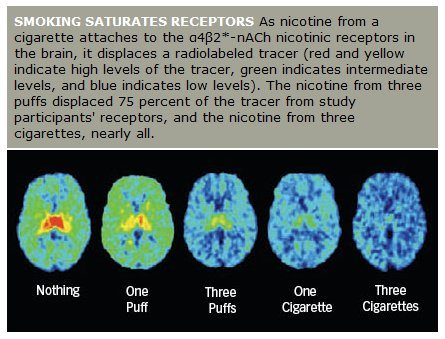
Over time, as you smoke more, your brain starts to change and you create more receptors to accommodate the nicotine coming to the brain. With time, your brain will want more and more nicotine to fill those receptors. Once you quit, your brain still expects the nicotine to fill those receptors – one of the reasons why the cravings continue even after the nicotine is “out of your system” (source):
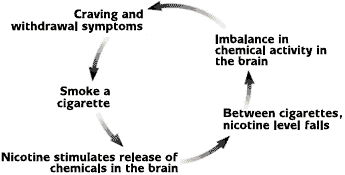
Once your nicotine cravings start, the withdrawal symptoms come: anger, anxiety, depression, irritability, impatience, trouble sleeping, and restlessness. The easy cure for these symptoms is, of course, more nicotine, which will ease the symptoms making you feel good but also release more dopamine, rewarding yourself for smoking that cigarette.
This creates a cycle in your brain making you believe that you need the nicotine to make you feel good again.
That’s right…
So many of the positive experiences that you believe are created by smoking a cigarette – such as feeling less anxious – are actually just the nicotine curing the symptoms of withdrawal. The nicotine withdrawal was creating the anxiety in the first place. Feeling restless and needing a cigarette to concentrate? You could be restless and having troubles concentrating in the first place because your brain wants a cigarette.
The majority of the time, the stress and anxiety you are trying to cure by smoking is actually caused by the addiction itself, and you wouldn’t feel it in the first place if you did not smoke.
It’s a poisonous circle, and it is a chemical dependency – much like alcoholism or any other drug addiction – and it’s why it is so difficult to quit.
The good news is, you don’t NEED to smoke, and you can break your addiction.
Next, I want to dig into the various types of “quit smoking” aids that you see advertised everywhere, before digging into our favorite method here at Nerd Fitness, and the one I used to break my addiction.
What you need to know about Patches, Pills, and Gum
First, there are multiple methods of quitting using aids like patches or gum.
Each method alone has, depending on where you look, on average under a 5% long term success rate. Many of the higher success rates you see are listed after a month or three months, and reduce greatly if you look out a year. Remember when looking at products and their success rates that they are trying to sell you something, and therefore want to make their product look the most successful.
Here is the big issue that many people might have with these methods: There is a lot more that goes into quitting smoking than the nicotine addiction. There are also habits, psychological elements, and chemical addictions. While some of these methods may make the cravings less intense, you still need to treat the other elements as well.
Nicotine Replacement Therapy (NRT): This is nicotine in patch, pill, or ecigarette form. You still are getting nicotine; the amount is slowly reduced over time, and since you’re not smoking, you can reduce the habit and chemical dependencies. Studies have shown that NRT can help increase your chances of quitting, however every study I’ve seen includes a note that the effectiveness of NRT appears to be dependent on the other methods the user is also using.
Prescription medicines: These have the highest success rates at about 7%. The most popular versions of this work by targeting the receptors in your brain or by inhibiting the re-uptake of dopamine. You need to get these from your doctor. If you want to go this route, make an appointment with your primary care physician and take your smoking log (we’ll talk about that below) with you. This will not only be helpful information for your doctor, but will show them that you’re serious about wanting to quit.
I personally tried every method except for medicine. The patch gave me super vivid nightmares, which some people enjoy, but I couldn’t handle.
If you think you need an additional piece of support to wean off the nicotine, there’s nothing wrong with that. I ended up quitting using the rest of the methods here, without the use of any sort of NRT, but it could be helpful if you are really struggling.
What about E-Cigarettes?
One method of helping assist people quit that’s gaining popularity fast is the e-cigarette or vaping.
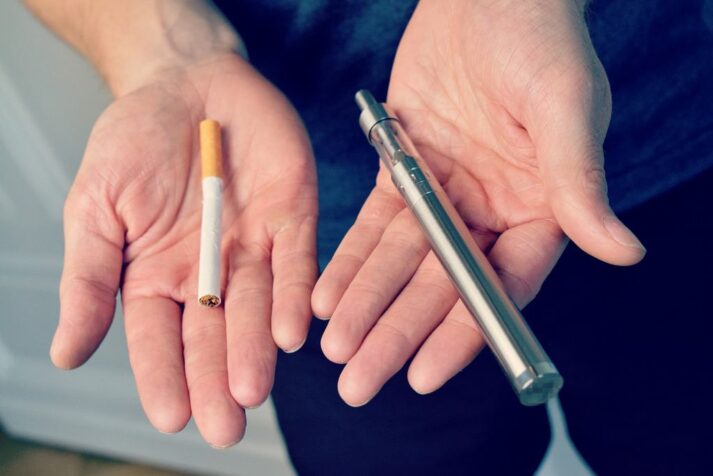
The e-cigarette is an electronic vaporizer which uses a liquid version of nicotine that you smoke. They are a relatively new product to the market (within the last 10 years in the United States) and have been the subject of numerous discussions, lawsuits, and political arguments (here’s a detailed history, if you’re interested).
It’s too soon for studies on long term health effects, but short term, the general consensus is that while they may less dangerous than smoking a traditional cigarette, they still contain nicotine and a slew of chemicals (pdf), are still highly addictive, and don’t really count a healthy alternative.
Basically, they’re kind of like a “paleo cookie.” Compared to a traditional cookie, it contains slightly fewer unhealthy ingredients; however, just because it’s marketed as an alternative doesn’t mean it’s “healthy.”
I’ve had a lot of people tell me that they have succeeded in quitting smoking using e-cigarettes, mainly because you can reduce the overall amount of nicotine while still “smoking.” You can purchase different nicotine levels which allows you to get less nicotine each time you smoke (kind of like smoking half of a traditional cigarette instead of a full one). This way, they were able to slowly reduce the nicotine addiction, and then break the habits associated with smoking.
Now, statistically studies show about a 1-2% increase in short term success over the nicotine patch, and about a 3-4% increase in success rates over nicotine gum (depending on the study, the rates are about 7, 5, and 4.1%, respectively). Longer term (over 6 months), however, rates flatten out and end up being about the same as the patch, and some people just switch completely to e-cigarettes and then never quit.
Remember that with this method, you still need to reduce the nicotine levels over time, break the nicotine addiction and change your habits.
Okay! Regardless of whether you choose to implement one of the above aids, we are going to help you address the root cause of your addiction and then move onto solutions to breaking free.
Breaking The Addiction the Nerd Fitness Way
I’m not going to tell you to go around the house and break all of your cigarettes in half and flush them down the toilet.
Quitting smoking is a process, and while I’d love for it to be something that people can just put down and never pick up again, for the majority of us, that’s just not how it works.
The first thing we’re going to do is start planning, and this is just as important as the actual quitting stage, so don’t rush it!
FIRST, WHY DO YOU SMOKE?
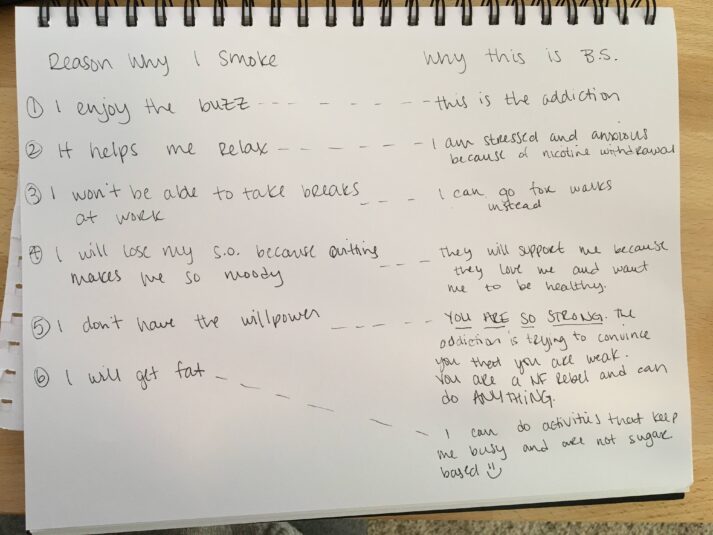
Do you enjoy it? What reasons do you have to continue smoking? What objections come up when you think about quitting? Think about these reasons. Write down a potential list of reasons why you still smoke. Here are some common examples:
You enjoy the “buzz.”
You’re stressed out/you have anxiety and it helps you relax.
All of your friends smoke, and you’ll lose your friends.
If you don’t smoke, you won’t get a break at work.
You’ll lose your significant other because you get moody without cigarettes.
You’re not strong enough to quit and you lack the willpower.
You have too many other things going on and you can’t handle the stress of quitting.
Now, look deeply at each of the reasons you came up with. Many of these reasons are likely based on one of two things: addiction or fear.
It helps you relax (addiction); you’re afraid of the changes that will happen in your life you don’t smoke (fear); afraid of not being in the right crowd by quitting (fear); think that you’re not strong enough (fear).
Now, fear is actually just a part of the addiction – your brain is afraid that you’re actually serious about this and are going to try to deprive it of its nicotine. Even though one part of your brain knows you should quit, another part of your brain wants you to keep smoking, so it is going to create every barrier that it can.
I want you to truly think about the reasons that you continue to smoke, why it’s a valid reason, and a counter point to it. Here’s mine:
Understanding the reasons why you continue to smoke, that they are the addiction speaking, accepting that you have an addiction, and that you are afraid to quit are big steps to move towards being able to quit, and the first step you need to take to be able to dispel your concerns and fears about quitting. It’s much easier to go up to bat against the games your mind is going to try to play with you if you understand that they are just games and part of the addiction.
FIGURE OUT DEEP DOWN WHY YOU WANT TO QUIT
You might say, “Why? I want to quit because it’s bad for me and because it’s expensive, duh.”
Now, while health and cost are great reasons to want to quit, it’s helpful to think deeper down. Keep asking why. We all knew it was something that could kill us and drain our bank accounts when we started, yet we tried anyway.
About ten years ago, I went to visit my Great Aunt in a nursing home, where she was dying from lung cancer caused by smoking, and lit up a cigarette on the way home. I believed that I would stop “before that happens to me,” even though my grandfather also died of lung cancer when he was 44. Sound familiar?
One Nerd Fitness Rebel told me that they quit smoking because it was too expensive. They got paid and could afford food for their children OR their cigarettes, so they quit smoking. The truth is that they didn’t quit because it was too expensive; they quit because the desire to feed their children outweighed their desire to smoke. If they had the money for both, they would have continued to smoke.
So this is what I mean by figuring out the deep down “why” you want to quit. If your WHY is flimsy, you’ll give up the first time things get tough. You need a DAMN good why.
Truly wanting to quit, or wanting your “why” more than you want to smoke, will be the backbone of your journey. So really think about it. You can have multiple whys, but make them specific, and use language like “I will” and “I need to,” and not “I should.” (poem by Shel Silverstein):
Write down your whys and put it somewhere you see it often as a reminder why quitting is important to you. If you think this could be helpful – paste that big why everywhere you go. One great example would be to put a picture of your child in the cigarette box, so you have to look at it every time you go to get a cigarette.
Change Your Mindset
The next step is to change your mindset about “giving up” smoking.
We talked a bit earlier about how when you smoke a cigarette, it releases dopamine in your brain, which is setting off a reward center in your brain and reinforcing the idea that smoking is something that is pleasurable. We need to start fighting that.
Stop thinking about what you’re going to be giving up, and start thinking about all that you’re gaining by quitting. You are freeing yourself from a life of enslavement to your cigarettes.
Here’s an excerpt that I really like from “My Cigarette, My Friend” by Joel Spitzer:
“He controls you totally. When he says jump, you jump. Sometimes in the middle of a blizzard or storm, he wants you to come to the store and pick him up. You would give your spouse hell if he or she did that to you all the time, but you can’t argue with your friend. Sometimes, when you are out at a movie or play he says he wants you to go stand in the lobby with him and miss important scenes. Since he calls all the shots in your life, you go.”
Think about how much extra time and freedom you would have if you didn’t smoke.
Think about how quickly you would have the money for a new Nintendo Switch. Think about all of the health benefits and how nice it will be to be able to see in full color again, to smell again. Think about being alive to hold your grandchildren and great-grandchildren.
At the same time, think about all of the negatives of smoking and why you don’t want to be doing it. Think about how you have to stand out in the cold, in the rain. Think about the coughing fit and the black phlegm you coughed up the last time you tried to go for a run. Think about cleaning out all of the ashtrays around your house, from inside your car, from outside. Think about how desperate you felt when you couldn’t gather up enough change to buy a pack the day before payday.
In addition, remember that a cigarette is not a “reward” for anything, or something to look forward to, and it should never be treated as such. It’s simply you getting your fix. If you think of a cigarette at the end of the night as a reward for going all day without one, you will have pleasant thoughts when it comes to smoking. If you tell yourself you are “getting your fix,” it changes the way you look at it to a negative one, which is what we want.
Determine Your Triggers
Next, we need to determine what our smoking habits are and what triggers us to smoke.
Without making any other changes, start keeping track of when and where you smoke. It doesn’t need to be fancy; just make a note of it and how many cigarettes you have. You can do this using a note-taking app in your phone, in a notebook, or even just a spare piece of paper that you keep in your pocket. Include details of what you’re doing at the same time if it’s relevant. Don’t overthink it. It should look something like this:
What you want to do here is look for patterns. Think about when you always smoke a cigarette:
For many people it’s in the morning with your coffee.
When you get in your car to drive anywhere.
After you finish an activity (such as a meal, a meeting, class, or sex).
When you’re drinking with friends.
It’s good to keep a journal like this over multiple types of days (workdays, weekends, vacation) so you can really establish when and where that “habit” trigger is going off. I’d suggest starting with 3 days: a work day and a weekend.
One Less, one Less…
Once you have your journal for a few days complete, you now know exactly how many cigarettes you’re smoking each day, and when and where you most want them.
The next step is determining if there are any areas where you can make an easy cut. We’re going to try to build some momentum here, by starting with the easiest place to cut back on a single cigarette. Can you smoke one less on your way to work? What about ONLY smoking one at the end of your lunch break instead of at both the beginning and the end?
Find your easy wins and start freeing yourself and building momentum.
And for this next week, just don’t have THAT one. Don’t worry about the rest – remember, we’re in this for the long haul (permanent freedom), and not worried about how quickly we can quit, only that it sticks.
I know that smoking one less for an entire week really seems like a tiny step and maybe pointless when you smoke 20 a day.
Why? We’re not trying to reduce one a week for the next decade until you don’t smoke anymore.
Instead, you’re proving to yourself with small victories that you don’t need cigarettes, that you can go without, and help build momentum to show yourself that you do have the ability to quit.
Pick A Date
When I was trying to quit, I would get physically upset and have nightmares if I picked a date, I was that attached to smoking. You don’t have to pick a date just yet, but you will need to eventually. Otherwise you will keep saying “I’ll quit tomorrow” or “I’ll quit when this pack is empty.” You’re allowed to pick tomorrow as your date, but instead of saying “I’ll quit tomorrow,” you say, “I am quitting March 29th, 2017.”
Once you do pick a date, don’t put it off, and throw away the remaining cigarettes you have. I ended up picking my date about a week beforehand.
Once you have a specific date to quit, don’t dread that day. Instead, look forward to it. It’s a freedom date. Think about how much better your life will be. Don’t dwell on anything that you think you’ll miss; those things are just your mind playing tricks on you. As soon as your mind says “Aw, man, I’m going to miss this so much,” divert it and think of the counterpoint to that argument.
Don’t wait for motivation – it’s fleeting. You’re going to have to cultivate discipline for this.
When picking a date, use timing to help you. Habit is huge when quitting smoking, so if there’s a time in the next few weeks where your habits will already be changing, use that.
When you’re looking at incorporating a bit of a shakeup in your life, such as quitting smoking, it’s oftentimes easier to do this at the same time as another big shakeup you might already have planned:
Are you moving?
Do you have a vacation coming up?
Are you starting a new job?
Did you join a new gym or start dating somebody?
Since your routines and habits aren’t set yet in a new situation (or you won’t be following them, like in the case of a vacation), it’s easier to drop bad habits at the same time. Plus, you’ll be focusing on your vacation, new job, new house, or new person, and as a result, you’ll have less time to focus on missing smoking.
While I was working on quitting, I started a new job, and I made it a hard fast rule that I was not to smoke at work.
I never mentioned to anyone that I smoked, and never took smoke breaks. Because of this, I didn’t form the habits that I had at my previous job to go out every hour to smoke, and the new friends that I made weren’t asking me to join them for that break every hour. This was a huge success for my progress towards quitting smoking. It helped me believe in myself: if I can go all day without smoking, then I could break free completely soon enough.
Now, I’m not saying you should wait until you move or until next Christmas vacation to quit – if you have nothing big coming up in the next month or two, don’t wait. Sooner is always better.
Please don’t email us saying, “I quit my job because you told me it would help me quit smoking!” 🙂
So look at your next month. Pick a date, and look forward to it.
Ask For Support
You are never alone. When you are ready, and you have your date and your WHY, it’s time to recruit your squadron.
Sit down with your friends and family and tell them that you’re going to quit, why it’s important to you, and ask for their support. If you explain why it’s so important, and tell them how they can support you, they’re more likely to take you seriously, and more likely to support you.
This includes anyone who you smoke around, or with, including your smoking friends at work. I know it may feel awkward or silly to dig deep into your feelings and talk to people you’re not super close to, but a simple sentence will suffice: “Hey, I’m quitting in 2 weeks, my son is having a baby and I’d like to be around to see it grow up. It would mean a lot to me if you could support me by not giving me shit every time I say no to going outside with you for a smoking break.”
Don’t be afraid to ask for specific help, too. If there is one day of the week that is more stressful and where your kids need to be in a million places at once and you normally smoke more, or feel more stress, see if a friend or parent can help out that day for a week or two. They would likely not only be glad to help, but knowing that others are putting in effort to help your success will help hold you accountable.
Ask your friends who smoke to tell you no if you ask to bum a cigarette, even if you pressure them and get upset.
Just like when making changes to your diet, you may see resistance, especially from friends and family members who smoke. The truth is, even if they know it’s best for you to quit, they likely don’t want to lose their “smoking buddy,” and may even feel personal guilt or shame if you succeed and they don’t.
Make sure that your friends and family understand that you’re not judging them for their decision to continue smoking just because you’ve decided to stop.
Accountability: Recruit Friends or a Squad
Adding an accountibilibuddy or squad/team to your efforts to quit adds an entire defense level to the attack of the nicotine.
Now it’s not just up to our brains (which can deceive and rationalize us!), but we have failsafes and support and people fighting alongside us here.
Figure out what will keep you personally accountable and put that system in place. Join a support group, start a special savings account, put a support line phone number (we’ll link to resources later in the article) in your wallet so it’s easily accessible.
A few ideas on accountability:
Give a friend $500, and for every cigarette you smoke, they donate $5 to your least favorite charity or a political candidate you despise. I bet you have one in mind!
Tell your kids that you will put all of the money from smoking into a savings account, and if you’re successful on quitting, you guys can take a family vacation with that money.
Since cravings pass quickly, having someone to call every time you have a craving can be key. Did you know that you can call some quit smoking hotlines every time you have a craving? (And they are free!)
Create a lunchtime walking group with people trying to quit smoking at work.
Attend meetings and/or counseling.
I want to give two special shout outs!
The Nerd Fitness Message Board Community: This is one of the best and most supportive communities on the internet, IMHO. I joined before I quit smoking and was afraid to post for a while about the fact that I was smoking, and when I finally admitted it, no one judged me and everyone was so helpful and supportive of my desire to quit.
The NF Facebook group about quitting smoking: I just created this for anyone reading this who is a reader of Nerd Fitness and looking for a support group. Not all of us have a great in-person support group (I didn’t!), so we’ve created this group just for any Rebel looking to quit smoking. You don’t have to be ready to quit now – but if you’re a smoker and would like to eventually quit, join us there!
Foolproof Your Batcave
While you’re working on smoking one less cigarette per day, we’re going to set up a foolproof system to help you quit, and by that I mean we’re going to “Hack our Batcave.”
This concept works whether we’re trying to quit smoking or eat better or exercise more. Because we’re so influenced by our environment, a FEW steps here, done once, can automatically influence every day after that.
Look back at that journal you made about your triggered moments and when you smoke:
Can you see when and where you are smoking the most?
Can you change your environment to make smoking more annoying for you?
For example, start by setting a concrete rule that you must not smoke inside your house any longer, you must go outside to smoke. You can still smoke the exact same amount as you’re smoking, the only difference is now you need to get up and go outside.
After you’re used to not smoking inside for at least a week, then I’d recommend adding “no smoking in the car” rule. This way, if you want to smoke, you need to do so outside, before you get in the car, or after you get out. This means you have to leave early to get places if you want a cigarette, and if you live in colder climates, you have to stand out in the cold.
Make smoking not only an annoyance, but something you need to consciously put effort into doing, while still giving your brain what it really wants (the cigarette).
The next step is to increase barriers between you and your cigarettes, and make the cost/time commitment of smoking higher than the benefits of smoking. What’s something you could do that would make you really have to work to get a cigarette?
In short, use your laziness to your advantage. Let your environment do the work for you:
Lock your cigarettes up in a box that you keep in your car. Every time you want to smoke, you have to get up, put pants on, get your car keys, go out to your car, unlock the box, get the cigarettes, etc. Ugh, that sounds exhausting, probably easier not to smoke!
My friend once broke a TV addiction by actually putting his in the closet! It was too much work to take it out and set it up every time he wanted to watch reruns, so he just read books instead.
Do you have kids? If your reason to quit is your kids, give them the key so you have to ask them for it, or keep it in their room so you have to see all of your child’s things to get that key.
I wouldn’t let myself bring cigarettes to work, and had to decide. Do I want an extra 10 minutes of sleep, or do I want my cigarette? Which one is worth more to me today? And as time went on, the cigarette won less and less.
A quick note on smoking in secret:
Some people use smoking in secret (telling people you quit when you are really still smoking) as a final barrier between them and smoking, because if no one knows you smoke, or thinks that you quit, you have to do a lot of work to hide the smoking from everyone around you, and the cost of getting caught is definitely higher than the benefits of actually smoking the cigarette.
Now, I used this method in part by starting a new job and not telling everyone that I smoked, and when I was taking a class at nights after work, when my classmate asked if I wanted to go out and smoke on our break, I lied and told them I didn’t smoke. I did this because I didn’t want to build the habit around smoking in these places while I was planning to quit.
That type of secret smoking is pretty harmless, and can be helpful; however, telling your loved ones that you quit and then hiding cigarettes from them often has much higher implications than it’s worth, including potentially destroying your support system at home. So please think twice before you attempt to smoke in secret.
Change Your Habits
If you’ve ever tried to build a fitness habit (like drinking less soda or going to the gym consistently), you know that changing or creating one habit takes quite a bit of time and discipline.
When you’re quitting smoking, if you smoke a pack a day, you potentially have 20 different habits you need to break. It’s habit to smoke after a meal, it’s habit to smoke while driving, it’s habit to smoke when you drink coffee. That’s not one smoking habit, that’s three different habits.
For some things that include a smoking habit, we remove the cigarette from that habit (like, for example, if you habitually light up every time you get in your car).
For other things, it may be easier to change the habit altogether:
Do you always smoke a cigarette with your coffee first thing in the morning? Start bringing your coffee with you, or having it at work, so you can’t also have a cigarette at the same time.
Do you always smoke after a meal? Instead of going outside and smoking, go brush your teeth or go for a walk (maybe on a treadmill for a while, to prevent you from going outside, where you normally would smoke).
Start making habit changes, one at a time. I recommend one per week at the fastest pace, but maybe slower if that seems too much for you. Each habit change should should remove at least one cigarette per day from your schedule.
It’s Quitting Time!
We’ve planned, we’ve started changing habits, we’ve built systems to help us, and quitting day has come.
If you followed the process above correctly, over a few weeks, you should already be smoking less than you were before, or at least be annoyed by the fact that you’re a smoker, and questioning how important it is to you.
In addition, you should be building momentum; you’re smoking less and less and building the confidence that you can, in fact, go longer and longer without a cigarette and that you won’t die without one.
And your quit date has arrived.
From here on forward, you don’t smoke. This is your new identity.
You’re not quitting, you’re not trying to quit; from now on, you’re a nonsmoker.
Quitting implies you are losing something, when in reality, you are gaining everything. Specifically, freedom.
Some people find it helpful to say that they are just choosing not to have a cigarette at this time. When my Mom quit, 20+ years ago, she always told herself she could have one again when she was 65, because after 30 years of smoking, the thought of never smoking again was too painful. She’s now 67, and still smoke free, and has no plans to smoke again.
The Withdrawal. Ruh Roh.
Your first few days will vary in terms of arghhh-ness, depending on how motivated you are, how many cigarettes you were smoking daily before you quit, etc.
It does takes at least 3-4 full days for nicotine to completely leave your system, and withdrawal symptoms will be the most intense the first two weeks. Ugh. A craving will last, on average, no more than three minutes at a time. However, when dealing with nicotine withdrawal, those three minutes will feel like forever.
The most common side effects are anxiety, irritability, dizziness, headaches, tiredness, constipation, coughing, lack of concentration, and depression. No way around it, this part is not fun.
These will go away with time, but it’s often hard to continue to not smoke when you don’t feel well and you’re depressed. They are worst the first few days, peaking at 48-72 hours. This sucks, because this is when you need to build momentum for the long run, but it’s easy to say “it’s only been a day, I’ll just have one and start again tomorrow.”
After the nicotine is out of your system, your brain still needs to repair, which will take, on average, a few weeks to a few months. The cravings will not be as intense, but will likely still be there on some level. The intensity and length of these will be dependent on how much and for how long you smoked. Every person is different.
Personally, I struggled the most on the 3’s – 3 days, 3 weeks, and 3 months. Thankfully 3 years was easy!
Cravings can start at any time for no reason: it could be associated with a memory, a ritual, or seem to be completely random. My mother called me a little while ago a bit shook up and told me that, after 20 years of not smoking, she went into a gas station and, without thinking, asked the clerk for a pack of cigarettes, followed by “…wait a minute, no, I don’t smoke!”
The reason why I started having intense cravings and dreams writing this article, is because during writing, I was thinking about nothing but smoking, and my brain was reminded of it.
Thankfully, the longer it’s been since you’ve had a cigarette, the easier it is to just shake it off and ignore it.
IN ADDITION TO THE WITHDRAWAL, YOU ARE GOING TO GET SICK.
Now, one thing to warn you about that many people don’t expect is the “Smoker’s Flu.” Yep, even though you’re doing what is the healthiest thing you could possibly do for your body, you’re likely going to have flu-like symptoms. Sore throat, tightness in the chest, overall fatigue, headaches, and constipation are just a few in addition to the coughing.
Coughing and coughing up black mucus is not only a normal part of the process, but a good thing. You might feel like you have the worst cough or flu that you’ve ever had. This can last consistently or be on and off for weeks or months.
It’s a good thing, though! Your body is starting to try to repair all of the damage that was done to it by smoking, and that is a lot of hard work.
Obviously, if the cough gets too bad, or you start coughing up blood, it is a good idea to go to the doctor and get yourself checked out.
Quick note on exercising: Intense exercise such as sprints will often make the coughing seem worse. I can’t tell you how many times I’d end up hunched over having a coughing fit at CrossFit after I quit, way more than when I was a smoker. However, it got easier and easier each time, and eventually I wasn’t coughing at all. If you’re having bad coughing fits, talk to your doctor, or stick to some lighter strength training for the first few weeks after you quit.
Withdrawal and Coping Mechanisms
The first week or two of quitting, you may feel like you’re only thinking about smoking, and it’s probably true – your brain has created grooves and pathways where it expects smoking to fill the void and it’s wondering where it is!
Some of the withdrawal signs of nicotine are anxiety, irritability, anger, and difficulty concentrating.
1) Learning basic breathing exercises and quick meditations are invaluable here. When you feel a craving coming, or the irritability starting, stepping into the stall in the bathroom or a corner (the key is somewhere you can’t smoke. NOT outside or in your car) to meditate for a few minutes when you’re freaking out at work can not only help you quit smoking, but can be a really valuable tool for the rest of your life (I STILL step into bathroom stalls and do meditations to help combat my non-smoking related anxiety or just re-center myself during a big event).
I really like the Headspace App – they have a few “SOS” sessions that are great.
2) When with your friends or significant other, tell them you need to step away for a few minutes, and ask for them to support you. It’s not that you are angry and leaving them, it’s that you need a few minutes alone to center yourself and get over the craving.
3) Take up going for brisk walks – this is not only good for your overall health, and how we recommend you start with fitness, but coupled with breathing exercises and meditations, can help combat all of the withdrawal symptoms. Walking outside in the sun can also help with vitamin D which helps combat depression too.
4) Get up and get a glass of water and drink the entire thing – this is great for your hydration, but also gets you doing something else that lasts just about the same length as a craving, and it uses your hands and mouth, which is something you want to do when you want a cigarette.
5) Find a fun activity that keeps your mind and hands busy: I took a drawing class when I quit. Knitting, drawing, doing jigsaw puzzles, playing an instrument, even playing a new video game – get excited about something that you can not do and smoke at the same time, and can help with the fidgets.
6) Replace an activity that allows you to smoke with a new, healthy habit – start a “quitting smoking” walking group at work for lunchtime, where you all go for a walk and hold each other accountable. Go to the gym first thing in the morning, or after work. Join a local swim team or a meditation club.
7) Going to a Support Group – We talked about this in the accountability section, but having people to talk to that are not going to tempt you to give in, but who are going through the same thing as you, can help a lot. Remember: nicotine is a drug, and we need all the support we can get to get off of it.
If you don’t have one in person you can lean on, try our message boards for an online group of supportive rebels.
8) Avoid high-risk situations – For the first week or two, keeping away from high risk situations (like going out drinking with a bunch of friends who smoke) is a great idea. This is the time you’re the most vulnerable, so if you’re seriously afraid you’ll slip up, don’t go. If you’re going out with a bunch of friends and you’re afraid they will not respect your decision and pressure you into smoking, they don’t have your best interests at heart. True friends will support your decision.
Note: Your brain is going to be looking for things that release dopamine, as it’s no longer getting nicotine which did that for it. Sugar also releases dopamine, so I recommend staying away from sugar or not using sugary treats as a coping mechanism. If you do that, you’re just replacing one addiction with another, and it’s a big reason why people end up gaining weight while they are quitting smoking.
Your mind will start playing games with you and trying to convince you of how great smoking was, how much you enjoyed it, how you miss your smoking buddies, etc. Just remember that these are games and keep reminding yourself of all the things that you are gaining by not smoking anymore.
What if I slip up or backtrack?
If you have a cigarette, here’s what you SHOULDN’T do:
Don’t feel ashamed for smoking.
Don’t declare yourself a failure and think that you need to start all over again
Don’t keep smoking the rest of that day.
If you slip up, and have a cigarette, do two things: first, be KIND to yourself, forgive yourself, then accept it and move on. There’s no use crying over spilled milk, right?
We’re all human and we all mess up. Forgive yourself: you are flawed, and that’s okay. So are your heroes.
You are still a nonsmoker, you just had a cigarette. The rest of the day isn’t over, so don’t say “welp might as well smoke a pack and try again tomorrow.” You never stopped trying! You hit a speedbump but kept going.
The past is the past; learn from it.
Why did you slip up? Can you learn anything from it? What can you do to prevent that from happening again?
One reason why I don’t love apps that count how many days it’s been since you have smoked is that if you have a good streak going, and you slip up and have one, it erases all of your progress. That’s not how this works. If you slip up, you’re still way ahead of where you were. You just have a data point that you can learn from.
Remember that just about everyone who has tried to quit smoking has failed. The ones who are successful are the ones who just got right back up and kept trying.
A quick note on going out drinking when you are quitting smoking:
So many people I’ve talked to say that they fail quitting smoking because they go out drinking and, when less inhibited, buy a pack and start up again. It’s true that the lack of inhibition makes it much easier to slip up while you’re drunk. Just like how diets often go by the wayside when you’re 3 pina coladas deep, you’re less likely to make great choices and instead your brain is gonna opt for pleasure, aka “crappy food” or “smoking” or “[insert whatever here].”
There are a few different methods you could follow here if this sounds like you:
Keep to the plan and try your hardest to not smoke. Ask your friends you’re going out with for support, and put an accountability system in place. Give a friend your credit card and say the entire night is on you if you smoke a cigarette, or give a friend complete control of your money for the evening so you can’t buy a pack of cigarettes.
Stay away from drinking for at least a few weeks, until the initial withdrawal is over and you’ve built up momentum.
Let yourself smoke one night a week when you’re out drinking. Buy some off a friend or throw away the rest of the pack before you get home so you won’t have them the next day.
The important thing to note is that if you choose the third option, remember that’s not a forever option, just an option at first.
Helpful Resources
If you’re looking for hotlines or local support groups, there are a lot of different options. Here are a few:
1-877-44U-QUIT: National Cancer Institute Smoking Hotline
1-800-QUIT-NOW: Smokefree.gov will connect you to your state’s hotline and help you find local resources.
SMOKEFREETXT: This is a free text message program and provides 24/7 encouragement, advice, and tips to help you quit.
Smoker’s Anonymous: This used to be called Nicotine Anonymous and is a 12 step program with local meetings.
What does Success Look Like?
How do you know when you’ve been successful? In my opinion, any day without a cigarette is a success. Every time you say no, that is a success. And you should be proud every time.
If you can go one day longer each time you try to quit, that is a success. Remember, if you slip up, no judgment or shame, you don’t go back to being a “smoker.” You don’t reset your success back to zero. All of the health benefits you got from not smoking are not null and void. You are just a nonsmoker who make a quick choice and will decide IMMEDIATELY to get back on track.
You’ve escaped from a drug addiction – and should be extremely proud of that!
Feel free to throw yourself a full party each and every morning, dress up your animals in costumes, get confetti cannons, etc. In lieu of this every day, maybe try some other things:
TREAT YO’ SELF: Consider putting the money you would have spent on cigarettes in a savings account, and after a certain amount of time (3 months, 6 months, etc), use that money to take your family on a vacation or buy something you’ve really wanted but couldn’t afford otherwise.
I personally quit back when I was still doing CrossFit, and rewarded myself with a CrossFit membership. It was something I really wanted, but at $200 a month I couldn’t afford both CrossFit AND smoking, so as long as I didn’t smoke, I could keep my membership at CrossFit.
As we like to say, reward yourself with things that reward you back. Don’t reward yourself with cake or something unhealthy, but rather reward yourself with something that encourages you to continue down this new path to awesomeness.
The most important thing to do when quitting smoking is to believe in yourself, change your habits, and not stay down if you fall. Once you start to build momentum, the task that seemed completely insurmountable in the beginning won’t seem nearly as difficult.
Take your time, change your habits (be patient and don’t expect it to happen overnight!), be kind to yourself if you do fail, and just get back up. Next time, you have a higher chance at success.
PLEASE: leave your comments or questions – we’ll be continually updating this article!
If you have already quit smoking, what made you successful?
If you’re struggling with quitting, what’s the biggest hurdle holding you back?


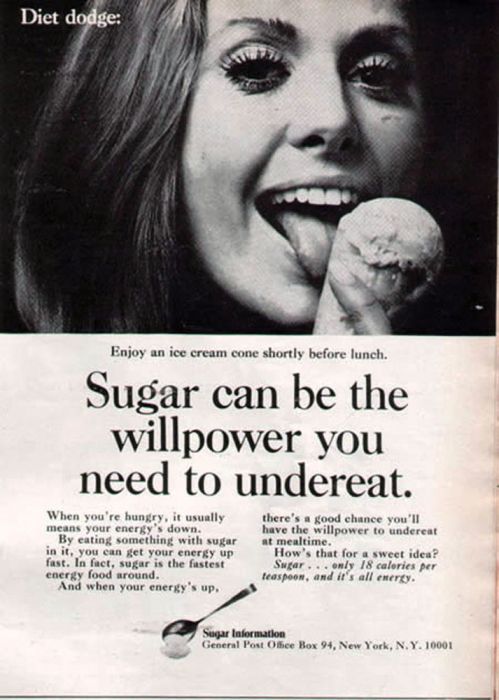
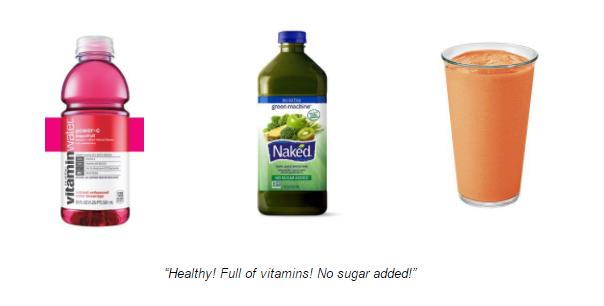


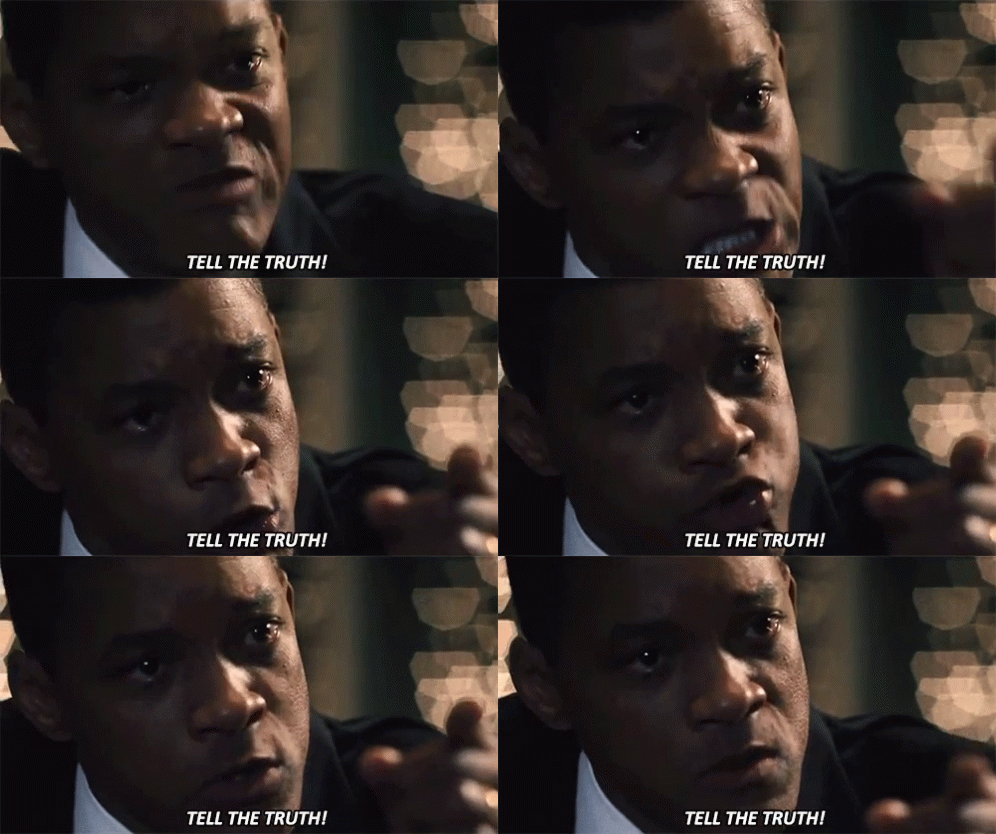





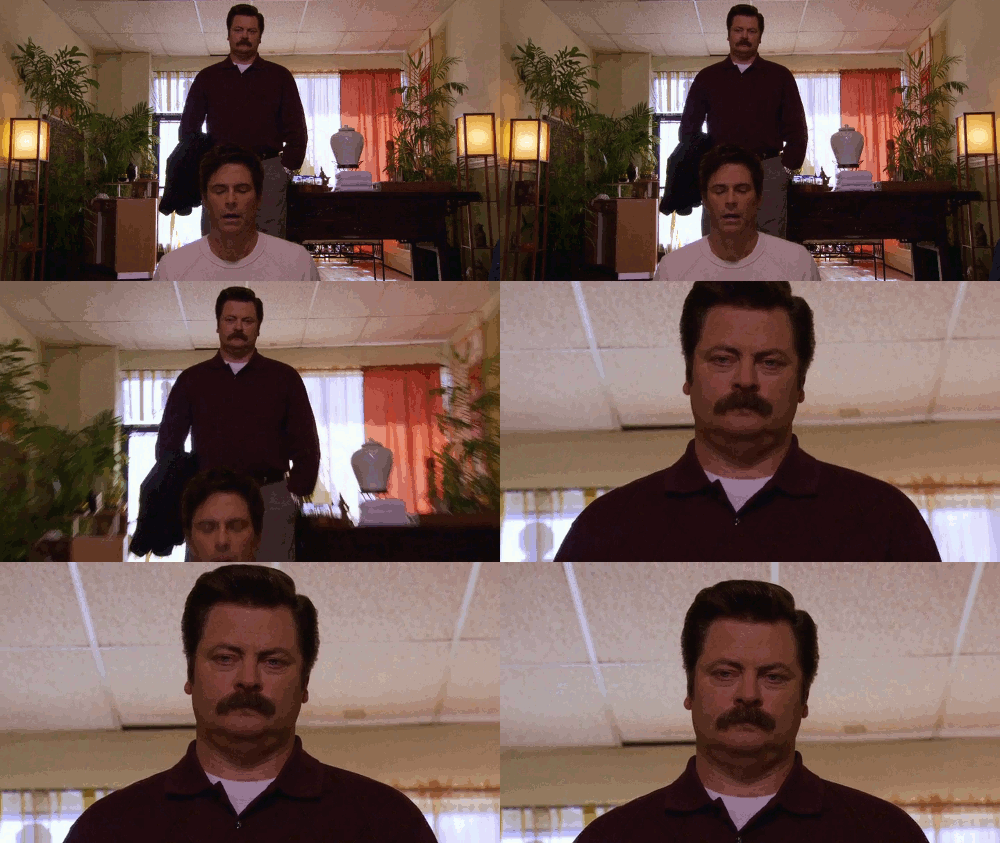
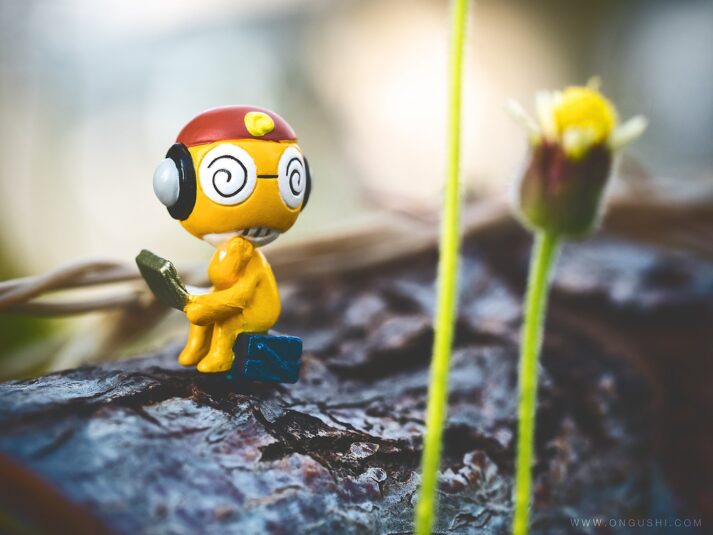
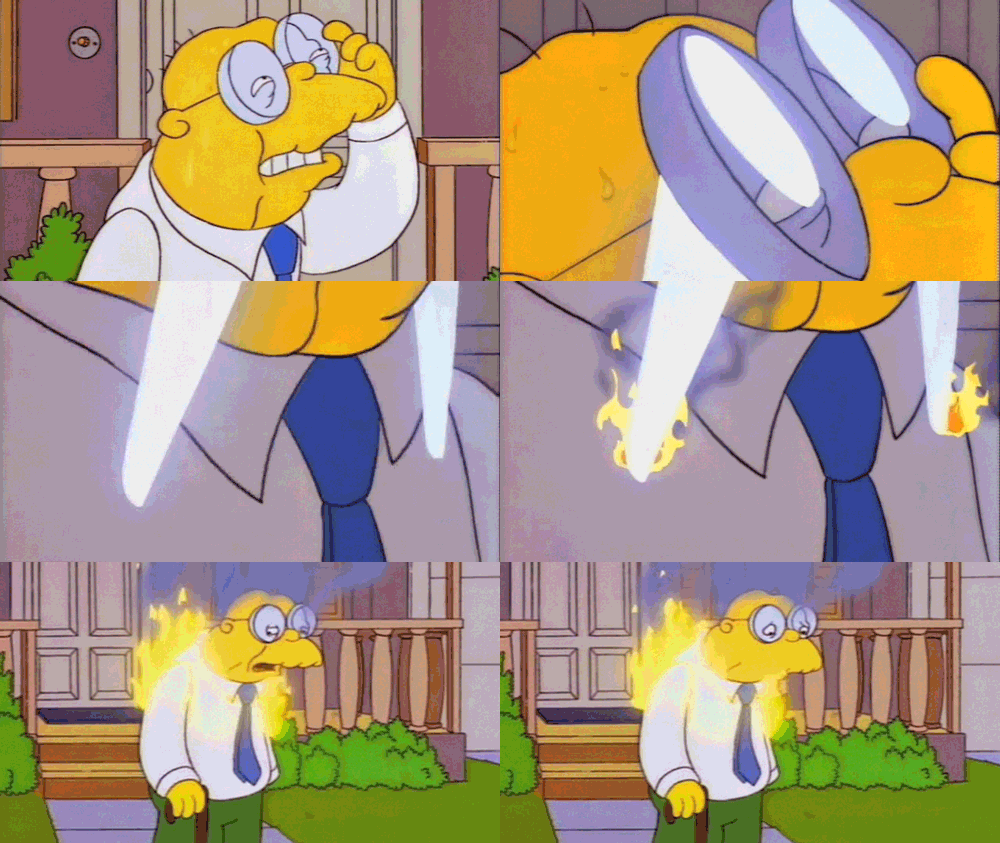
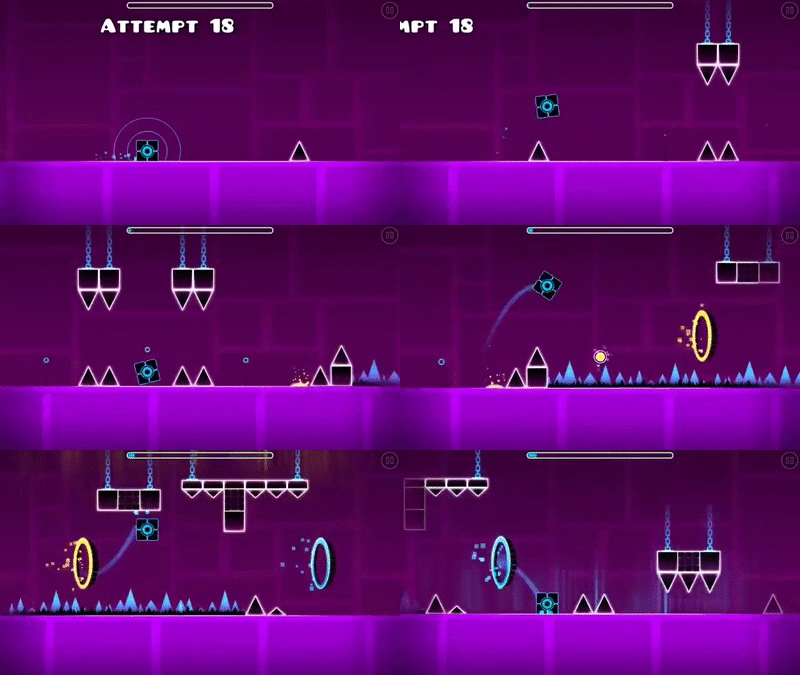



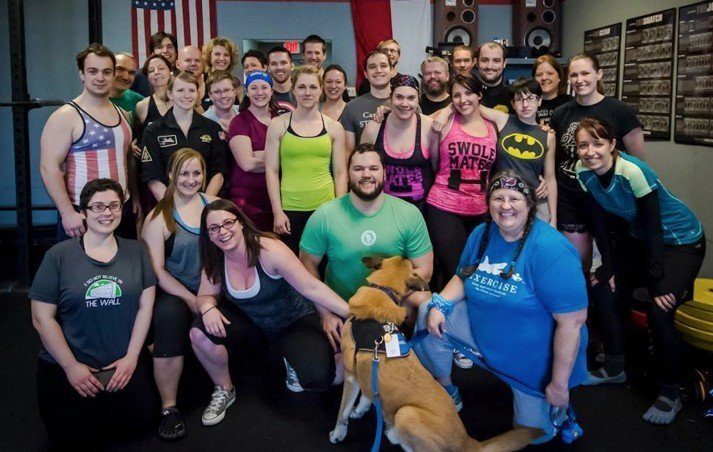
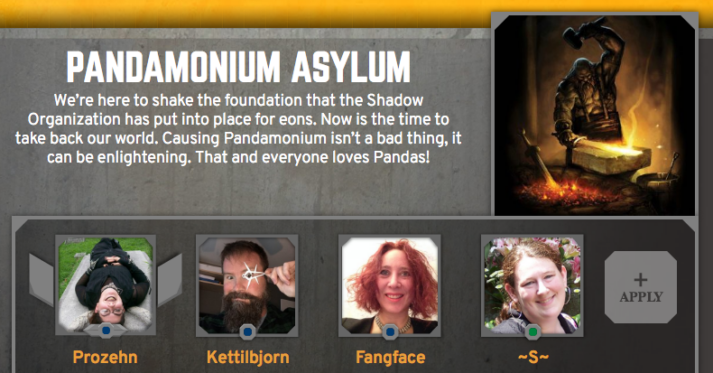
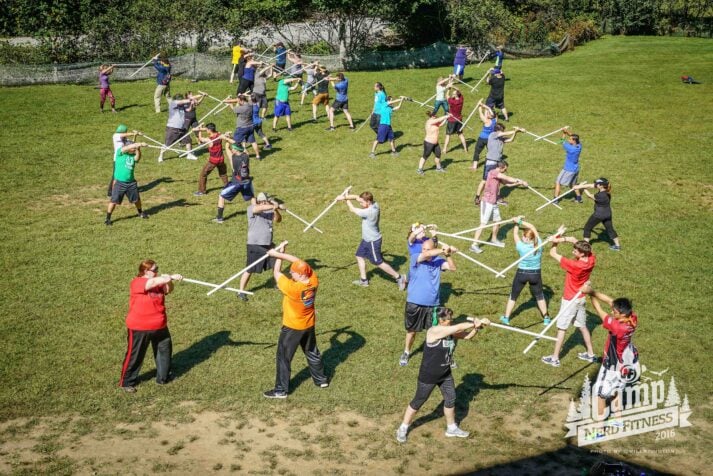


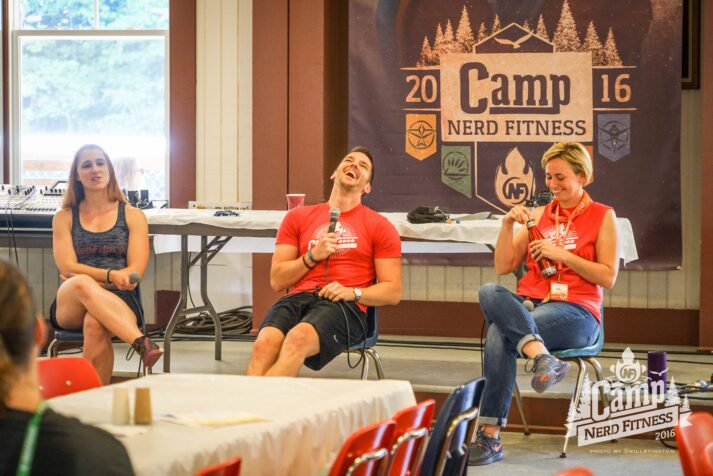


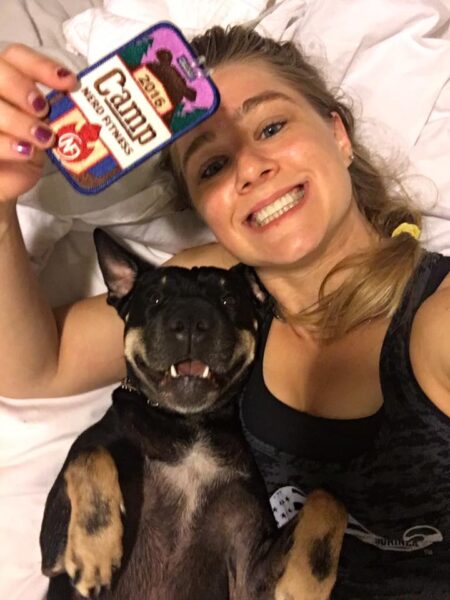
 While we think of it as a choice to smoke, the truth is, for the majority of smokers, it’s not a choice.